AI Hype vs. Proof: GxP Validation, Mapping, and Audits
What if 30 days of exploring AI helped organizations discover where it delivers real value, not just how to automate faster, but where it makes a difference?
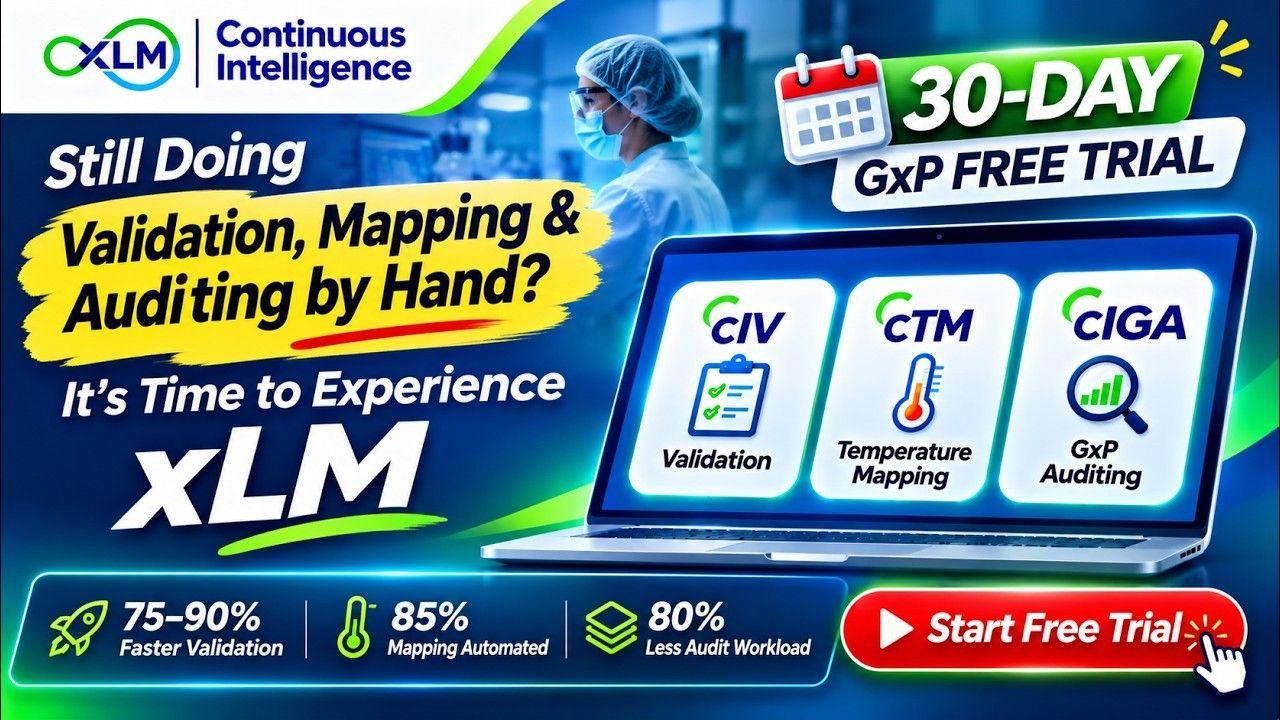
1.0. The Real Question Isn't Whether AI Works
A quality team is preparing for a system validation. An engineering team is reviewing temperature mapping data. Meanwhile, supplier quality specialists are chasing audit documentation ahead of an upcoming assessment.
Different responsibilities, but a familiar challenge: essential work increasingly consumed by repetitive activities.
Now imagine intelligent automation could accelerate these workflows. Requirements could become draft test protocols, environmental datasets could reveal meaningful trends, and supplier documentation could be organized into structured audit findings.
The possibilities are compelling. But in regulated life sciences, possibilities are not enough.
A successful demonstration may show what technology can accomplish under ideal conditions. It rarely answers the more important question: Will those capabilities deliver measurable improvements within the organization's actual operating processes?
For quality assurance, validation, and regulatory professionals, the answer must extend beyond productivity. It must account for accuracy, traceability, oversight, and defensible decisions.
This is where the conversation around AI in GxP operations needs to change.
Rather than committing to automation based on impressive demonstrations, organizations can use a structured, month-long evaluation to establish what works, what requires improvement, and where meaningful business value exists.
2.0. Why AI Adoption Requires More Than an Impressive Demonstration
A document generated in seconds looks impressive until a validation specialist discovers that it needs three rounds of correction before becoming usable.
The initial time saving quickly disappears.
This is one of the most overlooked challenges in evaluating intelligent technologies: speed does not automatically translate into operational efficiency.
Consider an automated qualification workflow. Generating test scripts faster is valuable, but the real question is whether those scripts accurately reflect requirements, include meaningful acceptance criteria, and maintain appropriate traceability.
If reviewers must reconstruct missing context or correct inconsistent outputs, automation may simply move the workload elsewhere.
The same principle applies across regulated operations.
True efficiency means reducing unnecessary work across the complete process, not accelerating one isolated activity. Quality means producing outputs that experts can review and defend. Business value emerges when those improvements can be demonstrated consistently.
The goal is not to prove that AI works in every situation. It is to identify where AI delivers dependable value, where human expertise remains essential, and what further validation is required.
This distinction matters because GxP compliance depends on controlled processes and reliable records, not the sophistication of the technology producing them.
A meaningful evaluation must therefore compare traditional and technology-assisted workflows, examine the quality of resulting deliverables, and determine the effort required to reach an approved outcome.
Only then can organizations begin separating AI hype from measurable operational value.
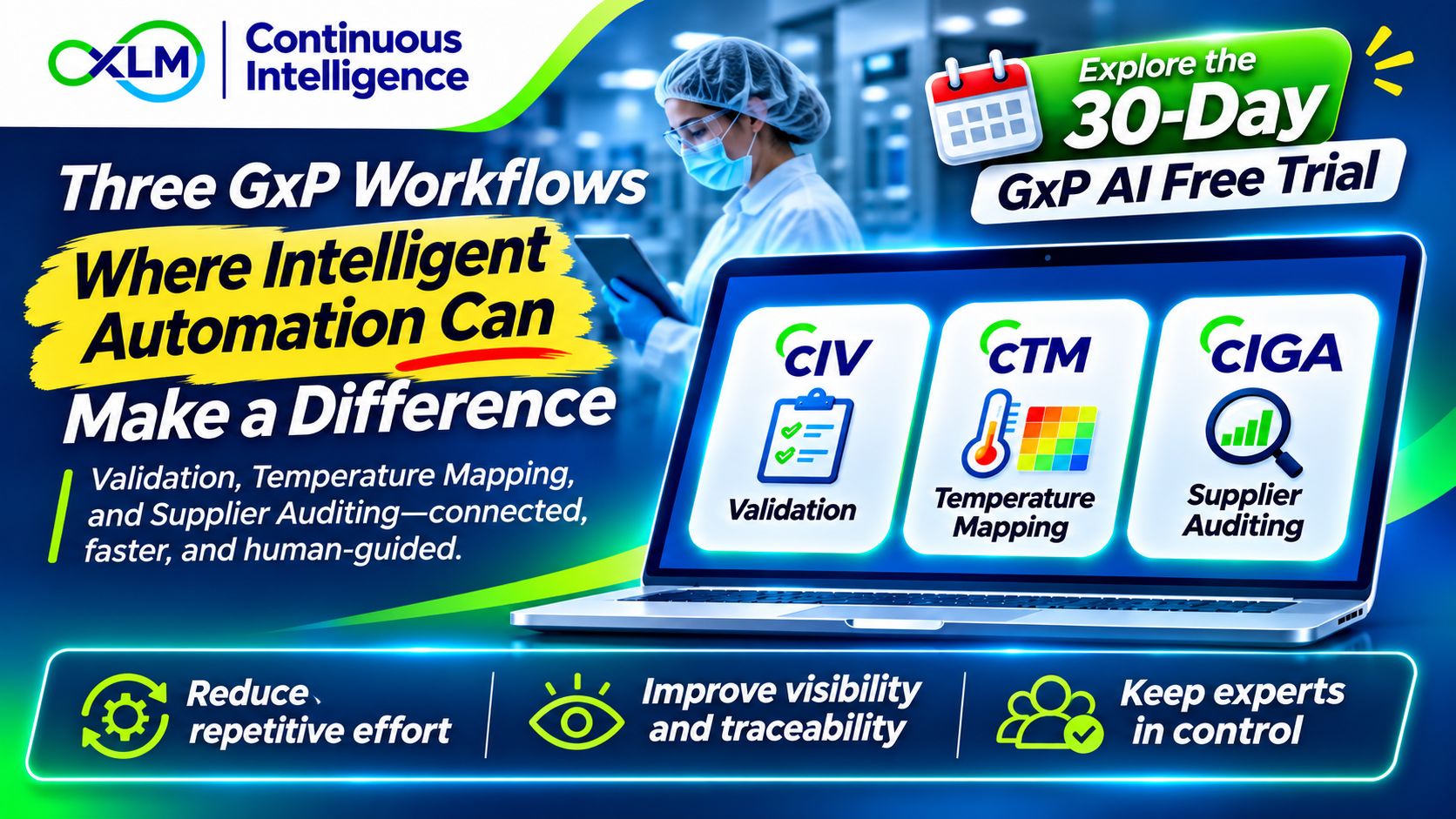
3.0. Three GxP Workflows Where Intelligent Automation Can Make a Difference
Consider computer system validation, where preparing requirements, assessing risks, generating test protocols, and collecting execution evidence can consume significant resources.
Through Continuous Intelligent Validation (cIV), teams can explore AI-assisted URS generation, qualification test preparation, automated execution, and requirement-to-test traceability.
The opportunity is not simply producing documents faster. It is creating a more connected validation process while qualified reviewers retain authority over the resulting records.
The same logic extends to environmental data.
Traditional temperature mapping requires engineering teams to interpret sensor readings, evaluate excursions, and document conclusions. Continuous Temperature Mapping (cTM) connects this information through spatial heatmaps, sensor relationships, Mean Kinetic Temperature (MKT) calculations, and environmental analytics.
Instead of manually reconciling disconnected information, specialists can investigate temperature behavior with greater context while retaining responsibility for interpreting results.
Supplier auditing brings its own version of this challenge.
Quality teams spend considerable time requesting documentation, reviewing supporting records, identifying gaps, and preparing reports. Continuous Intelligent GxP Auditor (cIGA) supports these activities through coordinated digital audit agents, supplier interviews, evidence checks, and report generation.
Here again, the objective is not to remove qualified auditors. It is to help them focus their expertise on supplier risk, significant findings, and necessary follow-up.
Automate what can be reliably automated, preserve human authority over consequential decisions, and maintain the evidence required to demonstrate control.
Across validation, temperature mapping, and supplier auditing, the underlying opportunity remains consistent: reduce repetitive effort without weakening the quality decisions that regulated operations depend upon.
The challenge is determining whether these improvements hold up when the technology is evaluated against practical scenarios.
4.0. From AI Potential to Practical Evidence: Why 30 Days Matters
Here is where the conversation changes.
Rather than evaluating technology through isolated demonstrations, organizations can examine an entire workflow, from initial inputs to reviewable deliverables.
The xLM 30-Day GxP AI Free Trial offers this opportunity through a structured evaluation of cIV, cTM, and cIGA.
The experience begins with an intake discussion to identify relevant use cases. A dedicated Forward Deployed Engineer then helps establish isolated application environments using tailored synthetic datasets.
This distinction is important. Teams can explore representative operational scenarios without introducing proprietary production information into the evaluation.
The validation sprint examines requirements, risk assessments, qualification protocols, test execution, and traceability. The temperature mapping sprint introduces environmental scenarios involving heatmaps, excursions, and MKT analysis.
The supplier auditing sprint then explores intelligent interviews by agents, evidence verification, and audit reporting.
Each stage produces deliverables that participants can inspect, challenge, and discuss. A controlled trial can help organizations discover limitations before committing to production deployment.
Consider a hypothetical biotech team evaluating cIV for a new Manufacturing Execution System (MES) module.
The team measures the effort required to prepare a URS and corresponding test scripts. Suppose the assisted workflow reduces preparation time by 70% with subject matter expert review that is expedited.
That would represent a promising result, not automatic proof of end-to-end efficiency. The team would still need to measure corrections, execution effort, and approval time.
Such findings create a foundation for a more informed decision.
At the end of the evaluation, participants receive sample deliverables and a personalized ROI business case to support further assessment.
Want to know more about the 30-Day GxP Free Trial?
5.0. Measuring ROI: Turning Time Savings into Business Value
For decision-makers, the central question eventually becomes financial.
But AI ROI in life sciences requires more nuance than calculating how quickly a document appears on screen.
A validation protocol generated in minutes has limited value if correcting it requires hours. An automated supplier audit creates little benefit if reviewers cannot establish the reliability of its findings.
xLM's trial page references 80–90% cycle-time compression as a potential outcome. Rather than treating that figure as guaranteed performance, organizations should approach it as a hypothesis to test against their own workflows.
The relevant measures include total cycle time, preparation effort, review cycles, rework, and the consistency of final deliverables.
Implementation costs, training, governance, and ongoing oversight also matter when estimating long-term value.
A useful business case distinguishes time saved from time transferred.
If automation reduces preparation work while increasing review effort, the net improvement may be smaller than expected.
But when teams can demonstrate reduced administrative effort, fewer avoidable corrections, and better use of specialist time, the potential value becomes considerably more credible.
That is the difference between a productivity claim and an investment decision supported by measurable results.
6.0. Keeping Humans at the Center of AI-Enabled Compliance
The final piece is often overlooked.
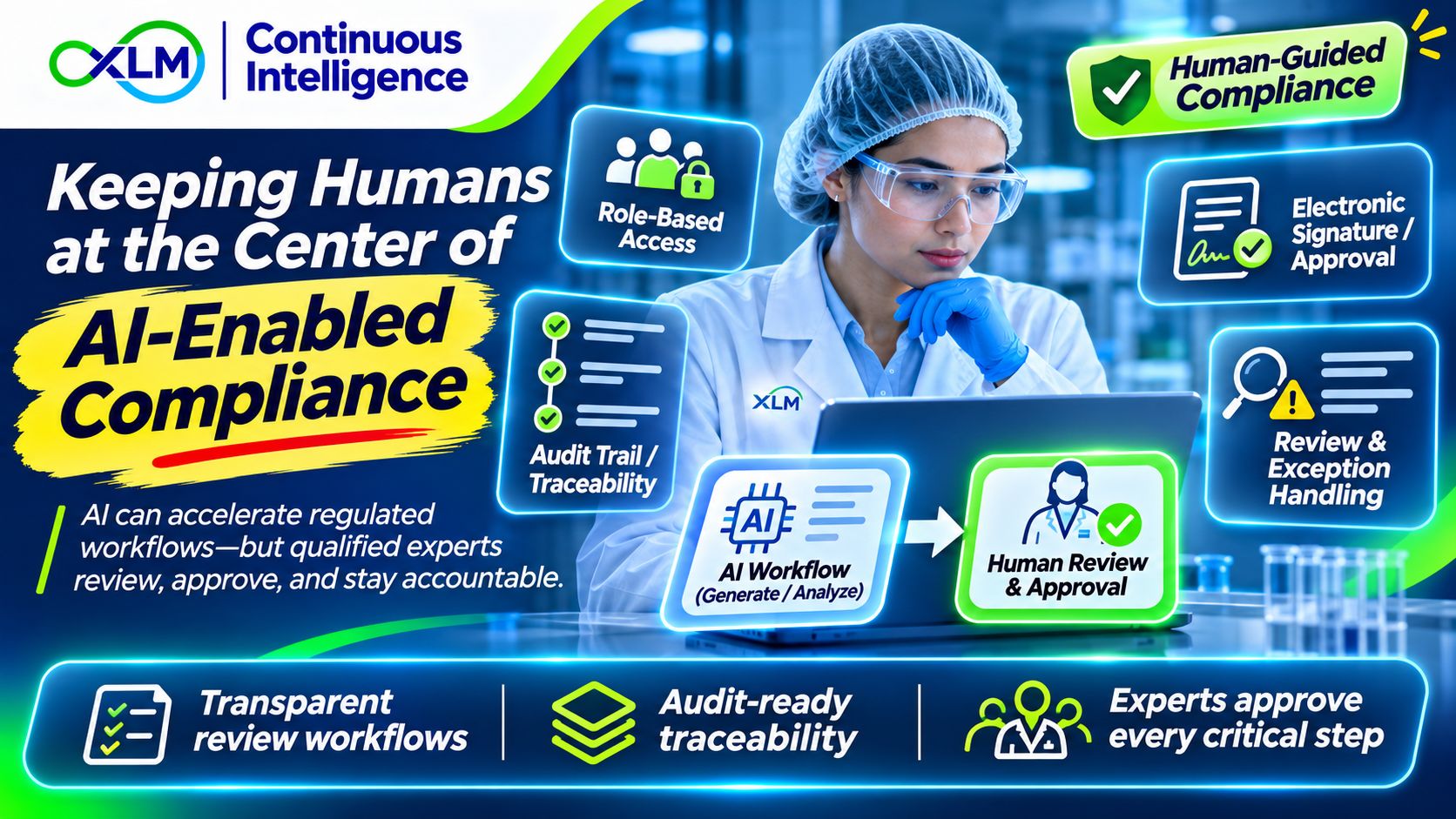
In regulated life sciences, automation can support important activities, but it does not remove the responsibility of qualified personnel to evaluate and approve consequential outcomes.
A meaningful human-in-the-loop (HITL) approach begins with people defining requirements, acceptance criteria, risk boundaries, and intended use.
Intelligent systems then generate or process information within those boundaries. Authorized specialists examine the results, resolve discrepancies, and approve applicable records.
The trial environments incorporate controls such as role-based access control (RBAC), audit trails, and electronic signatures, reflecting the importance of governance within regulated workflows.
These mechanisms support the evaluation of applicable expectations under 21 CFR Part 11 and EU Annex 11.
Trust in AI should come from transparent processes, understandable outputs, and documented oversight not automation alone.
This approach also changes how organizations think about efficiency.
The objective is not to eliminate review, but to make review more focused and meaningful.
When repetitive preparation decreases, experienced professionals can dedicate greater attention to interpreting results, evaluating exceptions, and making defensible decisions.
That is where automation and human expertise can reinforce one another, rather than compete.
7.0. The Next Step Is Evidence, Not Assumption
For life sciences organizations, the opportunity is no longer simply to explore what intelligent automation can do.
It is to determine where it can improve established processes without compromising control.
A structured evaluation provides a practical way to challenge assumptions, examine outputs, identify limitations, and develop a realistic business case.
The question worth asking is straightforward:
What could we learn about our own operations if we spent 30 days measuring what AI can actually improve?
Discover how 30 days of hands-on evaluation can help your organization measure the efficiency, compliance, and potential ROI of AI-powered GxP workflows.
Want to know more about the 30-Day GxP Free Trial?
About the Authors

About Nagesh Nama
Nagesh Nama is the Founder and CEO of xLM Continuous Intelligence and ValiMation, bringing nearly 30 years of experience in AI-driven GxP compliance, computer system validation, and regulatory technology for the life sciences industry. A recognized thought leader, he pioneered the industry's first Continuous Validation platform supporting compliant IaaS, PaaS, and SaaS environments under 21 CFR Part 11 and Annex 11. His work focuses on advancing intelligent validation, AI-powered compliance, predictive maintenance, temperature mapping, and GxP AI agents to help pharmaceutical, biotechnology, and medical device organizations accelerate digital transformation while maintaining continuous compliance. Nagesh is a member of the Forbes Technology Council and the Fast Company Executive Board, a contributor to Forbes and Fast Company, and has been featured by Microsoft for his work in AI agents.