
Validate Faster. Audit Smarter.
Stay Inspection-Ready.
Reimagine your GxP processes with Agentic AI - High ROI (<90 days) with HITL only for review and approvals.
Reimagine your GxP processes with Agentic AI - High ROI (<90 days) with HITL only for review and approvals.
cIV automates URS creation, generates intelligent test cases, and executes tests with unmatched precision without human intervention. It delivers GxP-ready URS, test scripts, and executed protocols in minutes.
Accelerate Software Validation with AI


From your first review to ongoing audit readiness in three steps.
We review your current GxP processes to identify where validation cycles are slowest, where audit coverage is inconsistent, and where data integrity carries the most inspection risk.
Your selected apps go live within your environment. Each one generates evidence, enforces traceability, and routes decisions to the right approvers from day one.
Continuous Intelligence monitors your validation status, audit schedules, and data integrity posture on an ongoing basis. Deviations are flagged early. Records are always export-ready.
Transform manual validation cycles into AI-powered parallel execution with automated IQ/OQ/PQ generation and full traceability.
Hours, Not Weeks
AI-powered parallel execution
90%+ Cost Savings
ROI realized in under 3 months
Full IQ/OQ/PQ
Automated traceability matrix
24/7 Automated
Zero manual data input required
85% Less Effort
Full compliance maintained
70% Cost Reduction
AI-driven efficiency savings
3x More Audits
Same team, triple throughput
80% Less Effort
AI-powered risk scoring
Zero Gaps
Complete structured coverage
4–8 Week Cycles
Manual bottlenecks slow every release
$50K–$200K per Cycle
Rework and documentation gaps
80% Manual Work
Teams stretched beyond capacity
Hours, Not Weeks
AI-powered parallel execution
90%+ Cost Savings
ROI realized in under 3 months
Full IQ/OQ/PQ
Automated traceability matrix
Manual Logging
Prone to human data entry errors
Late Detection
Issues caught only post-study
High Labor Costs
Resource-intensive monitoring
24/7 Automated
Zero manual data input required
85% Less Effort
Full compliance maintained
70% Cost Reduction
AI-driven efficiency savings
4–6 Week Cycles
Manual evidence & reporting
SME Bottlenecks
Dependent on key personnel
Coverage Gaps
Critical findings missed
3x More Audits
Same team, triple throughput
80% Less Effort
AI-powered risk scoring
Zero Gaps
Complete structured coverage
Leading pharmaceutical, biotechnology, and life sciences organizations rely on xLM to accelerate compliance, modernize validation, and drive operational excellence through Continuous Intelligence.

Oscar Robles
Director, Quality Systems at OrganaBio
Explore expert perspectives on AI, quality, compliance, manufacturing, validation, and digital transformation. Discover practical insights, emerging trends, and real-world strategies shaping the future of GxP manufacturing.
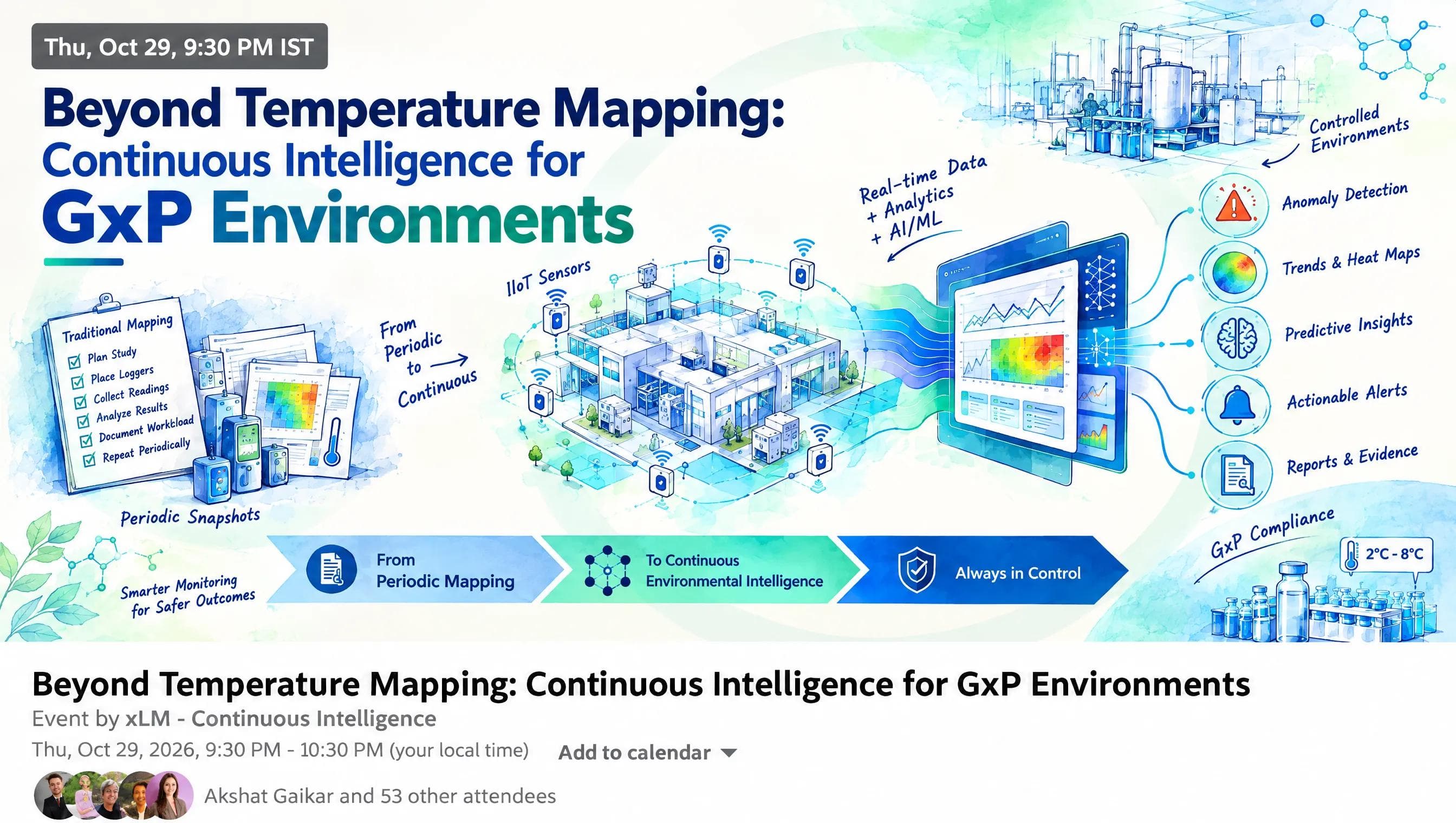
Discover how Continuous Temperature Mapping (cTM) combines IIoT sensors, real-time analytics, and AI/ML to identify environmental drift earlier and strengthen GxP monitoring, data visibility, and inspection readiness.

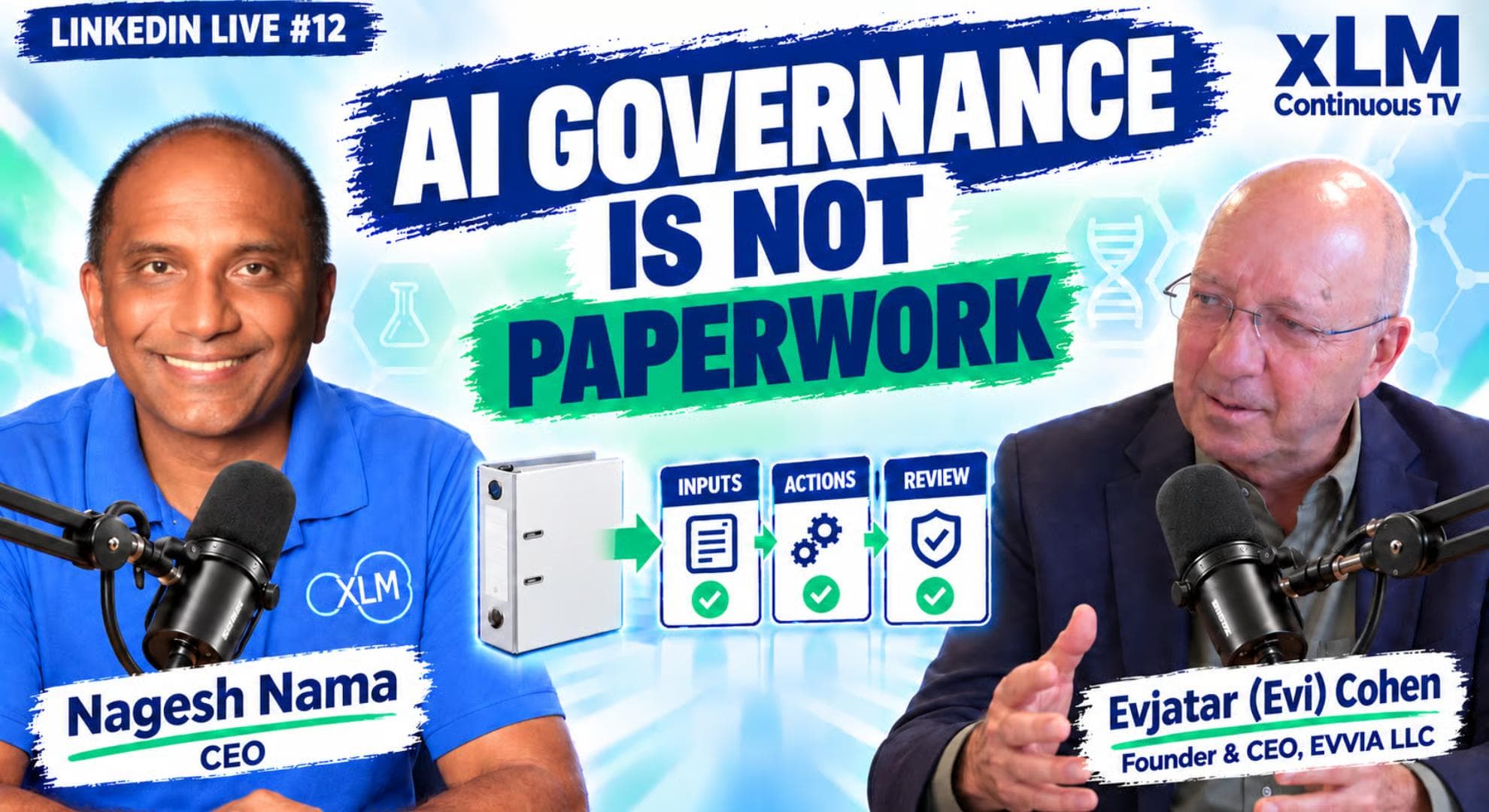
Explore AI in GxP beyond governance with operational evidence, risk-based assurance, agentic AI, human oversight, and continuous assurance for GxP operations.

Explore AI credibility in life sciences and how GxP validation evidence can become a connected, defensible argument for FDA regulatory decisions involving AI models.
Dive deeper into our complete library of articles, case studies, and industry insights.
View All BlogsThe definition: "Continuous validation is providing documented evidence to certify that an app not only met the pre-established acceptance criteria, but “continuous” to meet thus mitigating the risk of unknown changes."
Continuous validation is not just a "point in time" validation. It is a type of validation which connects various points in time (initial, patch, upgrade validation) with continuous smoke and regression testing. This feature provides the documented evidence that an app worked well not just at discrete points in time in the past but continues to function as expected in the present. This also mitigates the risk of any change in either the IaaS/PaaS layer (for cloud apps) or the underlying IT infrastructure (for on-prem apps) that can potentially alter its behavior.