
AI Model Validation in GxP: Translating ISO/IEC TS 42119-2
Learn how ISO/IEC TS 42119-2 enables lifecycle-based AI model validation for GxP compliance, continuous monitoring, audit readiness, and trusted AI governance.
1.0. Introduction
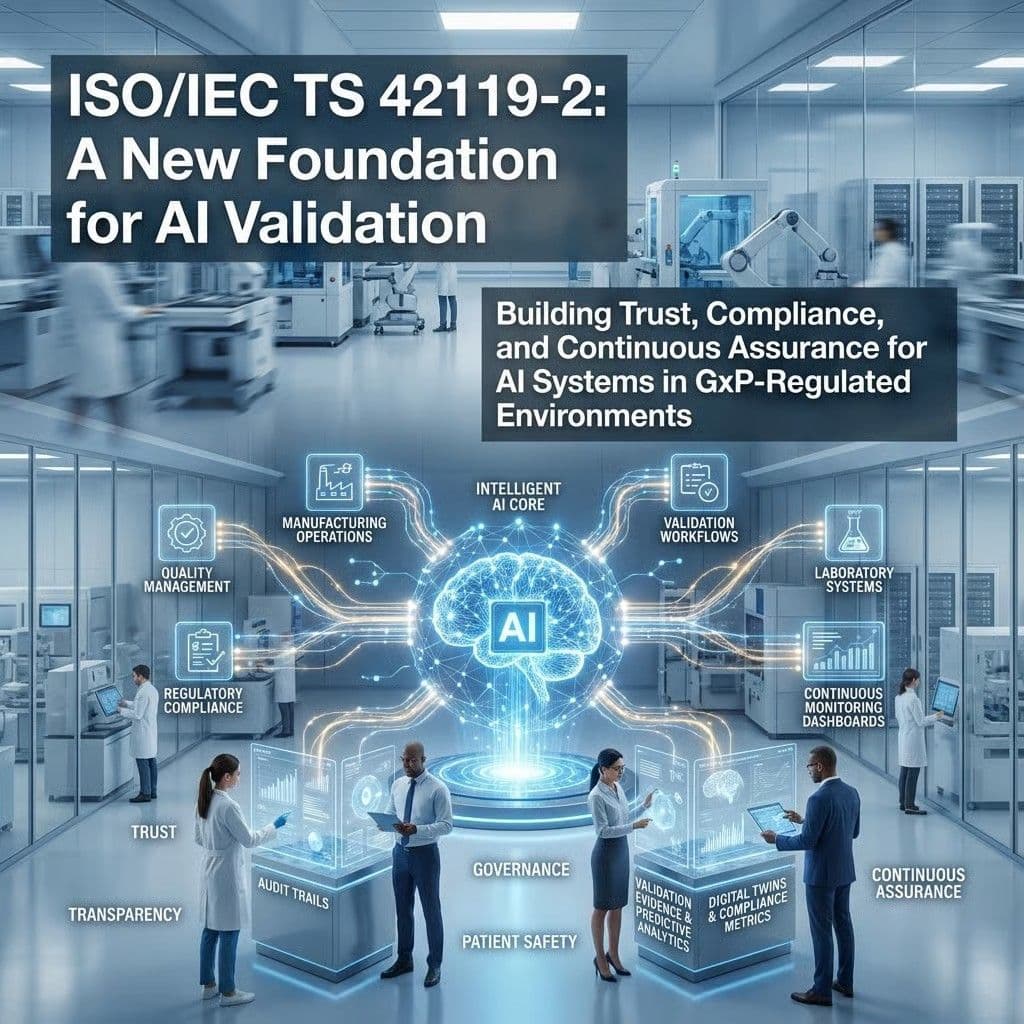
Artificial Intelligence (AI) has swiftly moved from experimentation to operational use across regulated industries. In pharmaceutical, biotechnology, and life sciences organizations, AI supports quality management, manufacturing operations, validation activities, regulatory documentation, laboratory workflows, predictive maintenance, and decision support. This shift creates a new reality for regulated enterprises: AI is no longer a future capability in isolated pilots; it is embedded in core business processes that shape work and decisions.
The development of ISO/IEC TS 42119-2 reflects this change. Traditional software testing approaches are insufficient for AI systems, which differ from deterministic applications. AI systems are data-driven, probabilistic, and evolve as models are retrained, prompts change, datasets update, and operating conditions shift. ISO/IEC TS 42119-2 guides testing AI systems to reflect these realities, helping organizations adopt structured, lifecycle-based assurance.
Though industry-agnostic, the specification is especially relevant in GxP-regulated environments. Here, AI can affect product quality, patient safety, and regulatory compliance. Regulated organizations must do more than show an AI system works during development or controlled tests. They must prove it remains fit for use over time, behaves reliably in real-world conditions, and produces evidence that withstands audits and inspections.
"The challenge is not whether to use AI, but how to validate it responsibly."
As AI adoption grows, the challenge is not whether to use AI, but how to validate it responsibly. ISO/IEC TS 42119-2 provides a foundation for testing AI systems to support trust, accountability, and continuous assurance.
2.0. Why AI Validation Differs from Traditional Software Validation
Traditional Computer System Validation (CSV) targets deterministic software. In conventional applications, the same input yields the same output if software and configuration remain unchanged. Validation verifies requirements, tests functionality, documents results, and confirms expected behavior before release.
AI systems do not fit this model. Their behavior depends on code, training data, model architecture, prompts, inference settings, and operating environment. AI is inherently probabilistic. Identical inputs may produce different outputs based on context, prompt wording, confidence thresholds, or model changes. Even unchanged applications may behave differently after retraining, fine-tuning, or exposure to new data.
CSV alone is insufficient. It validates the software wrapper but not the model’s behavior over time. A system may pass initial qualification yet degrade in production due to model drift, prompt changes, retraining, evolving datasets, or changing operating conditions. In generative AI, minor prompt changes can alter output significantly. In predictive models, input shifts can reduce accuracy or confidence. The system may remain “functional” yet unsuitable for its purpose.
For regulated organizations, this distinction is crucial. AI validation must go beyond confirming the application launches, interface works, or workflow completes. It must prove the model consistently produces reliable, appropriate, and controlled outputs in real-world use. Validation becomes a lifecycle activity, continuously demonstrating acceptability as conditions change.
"Software validation confirms the system works as designed; AI validation confirms it behaves as intended despite learning, adaptation, and drift."
This difference defines software versus intelligence validation: software validation confirms the system works as designed; AI validation confirms it behaves as intended despite learning, adaptation, and drift.
3.0. What Needs Validation?
Validating AI requires a broader view than conventional software. Effective AI validation involves more than confirming a model produces the expected output. Organizations must ensure the AI system remains trustworthy, explainable, controlled, and compliant throughout its lifecycle. Validation must address several critical dimensions to ensure the AI system delivers reliable outcomes in real-world environments.
- Intended Use - Validation begins with a clear purpose. The required control level depends on the system’s expected function and associated risks.
- Functional Correctness - The model must consistently perform its designed task accurately without unsupported assumptions.
- Performance - Key metrics like accuracy, precision, recall, confidence, latency, and response quality must stay within acceptable limits, assessed during development and after deployment with real data.
- Robustness - AI should handle edge cases, incomplete inputs, unusual scenarios, and changing conditions. Robustness testing defines reliable performance areas and when human review is needed.
- Explainability - Users and reviewers must understand why the model produced a specific output. Explainability is essential for trust, review, and regulatory justification.
- Fairness - The model should avoid systematic bias across data groups or use cases, especially when influencing quality outcomes, investigations, or prioritization.
- Drift - Validation must address changes in model behavior over time. Data drift, concept drift, and prompt drift can degrade performance without clear failure signals, requiring continuous monitoring.
- Human Oversight - For higher-risk cases, qualified personnel must remain accountable for critical decisions. Human-in-the-Loop (HITL) review ensures AI supports rather than replaces judgment.
- Traceability - Every output should link to model version, prompt version, dataset, validation evidence, and approval history. Traceability is vital for audits and inspections.
- Continuous Monitoring - AI systems require continuous monitoring to detect degradation, trigger revalidation, and maintain confidence in production.
"Validation becomes a continuous process of proving that AI remains fit for its intended use."
These elements define a comprehensive validation approach, ensuring AI is tested before release and governed continuously as it evolves.
4.0. AI Validation from a Practical GxP Perspective
AI validation is crucial in GxP environments where AI influences decisions affecting product quality, patient safety, and compliance. For example, an AI tool for deviation investigations that misses a root cause or misrepresents events can delay or misdirect investigations. A model for batch record review must consistently identify anomalies and avoid missing exceptions impacting release decisions. AI generating CAPA recommendations must provide relevant, traceable, and quality-aligned suggestions; weak recommendations waste resources. AI used for validation documentation or as a manufacturing copilot must produce accurate, complete, and reviewable content suitable for internal and external review.
"The issue is not just whether AI is useful, but whether it is trustworthy enough for regulated decision-making."
The issue is not just AI’s usefulness but its trustworthiness in regulated workflows with potential downstream impacts. Regulatory acceptance requires demonstrating control, consistency, and validation evidence. Organizations must validate software interfaces, model behavior, data, operating conditions, and human review mechanisms.
For GxP organizations, AI validation is essential for confidence. Without it, AI may speed work but cannot reliably support compliance.

5.0. Conclusion
AI is transforming regulated organizations, requiring evolved validation practices. ISO/IEC TS 42119-2 acknowledges AI’s probabilistic, data-dependent, and evolving nature, guiding appropriate testing. For GxP organizations, validation must extend beyond initial qualification to a lifecycle discipline.
Future AI assurance depends on continuously proving models remain fit for use. This includes validating functional correctness, performance, robustness, explainability, fairness, drift, human oversight, traceability, and continuous monitoring within an integrated quality framework. AI governance must align with regulated processes like change control, deviation management, CAPA, and audit readiness.
At xLM, these principles form the basis of Continuous Intelligent Validation (cIV), an AI-driven platform enabling lifecycle-based model validation through automated testing, continuous monitoring, Human-in-the-Loop review, end-to-end traceability, and inspection-ready evidence. cIV applies ISO/IEC TS 42119-2 concepts in a practical model for regulated enterprises, supporting continuous rather than reactive AI validation.
"Continuous Intelligent Validation transforms AI validation from a periodic activity into an ongoing assurance capability."
As AI adoption grows, successful organizations will treat validation as an ongoing commitment to trust, control, and compliance. In regulated industries, this shift is essential for safe, scalable, and defensible AI use.
"In regulated industries, AI validation is not a one-time event, it is an ongoing commitment to trust, governance, and compliance."
About the Authors

About Nagesh Nama
Nagesh Nama is the Founder and CEO of xLM Continuous Intelligence and ValiMation, bringing nearly 30 years of experience in AI-driven GxP compliance, computer system validation, and regulatory technology for the life sciences industry. A recognized thought leader, he pioneered the industry's first Continuous Validation platform supporting compliant IaaS, PaaS, and SaaS environments under 21 CFR Part 11 and Annex 11. His work focuses on advancing intelligent validation, AI-powered compliance, predictive maintenance, temperature mapping, and GxP AI agents to help pharmaceutical, biotechnology, and medical device organizations accelerate digital transformation while maintaining continuous compliance. Nagesh is a member of the Forbes Technology Council and the Fast Company Executive Board, a contributor to Forbes and Fast Company, and has been featured by Microsoft for his work in AI agents.