Beyond Temperature Mapping: GxP Insights from LinkedIn Live
Discover how continuous temperature mapping connects sensor data, spatial context, analytics, and human review to strengthen environmental intelligence in GxP.
1.0. Introduction
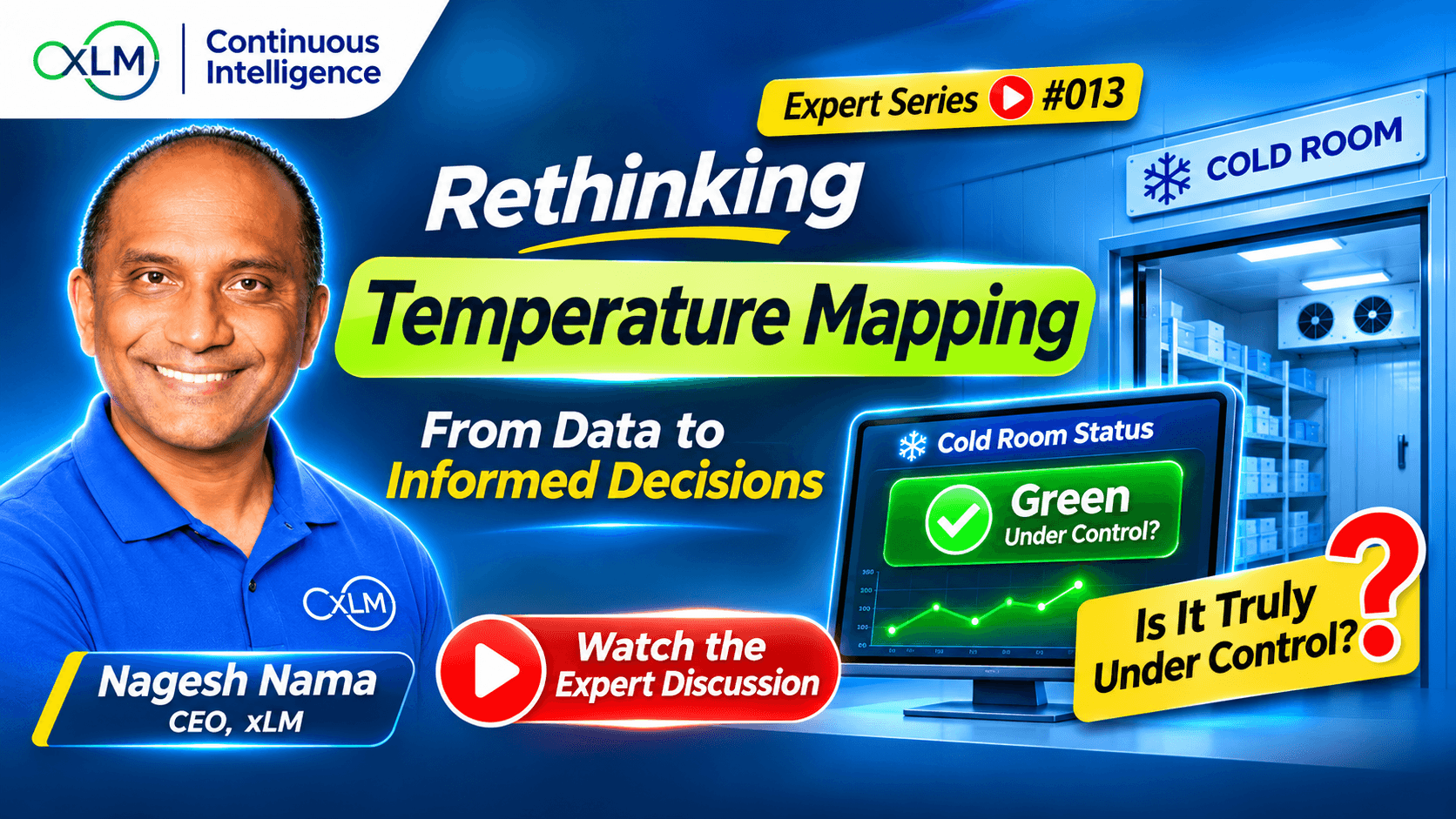
The cold room dashboard is green. Every visible reading appears acceptable. The monitoring system is running. It looks reassuring, but is the room actually in control?
Now consider that the latest mapping study predates a change in the racking layout. A sensor has not reported for 20 minutes, although its last reading was within limits. The dashboard has refreshed, but the data-processing job behind it has not completed.
Nothing on the screen necessarily signals a problem. Yet the information may no longer support the conclusion that everything is fine.
The screen is still green. But what exactly does it allow us to conclude?
Suddenly, the existence of an AI policy is not enough.
This was the central challenge Nagesh Nama explored during the 13th xLM LinkedIn Live :Beyond Temperature Mapping: From Periodic Studies to Continuous GxP Intelligence. The discussion was not about replacing established mapping practices or showcasing software menus. It examined a more consequential shift: connecting measurement, operating context, analysis, and review so that organizations can understand not just what happened during a study, but whether confidence in their environment remains justified over time.
The event also generated strong organic engagement with 110 registrations, 190 video views and 1,540 minutes viewed.
2.0. What Would Convince Us That AI Is Intelligent?
AI can produce fluent explanations, but fluency does not establish reliability. In a GxP environment, a convincing paragraph means little if the underlying evidence is incomplete, misleading, or difficult to verify.
Consider an early-warning model designed to identify potential temperature problems. Its value cannot be measured only by the events it detects. Teams also need to understand what it misses and how often it raises false alarms that send investigators searching for problems that do not exist.
A useful model must make its limitations visible. When room conditions or configurations change, it must also help determine whether its earlier learning remains relevant. Confidence should come from evidence, not simply from the passage of time or repeated use.
Intelligence is not about generating a confident answer. It is about supporting a better decision and showing the evidence behind it.
The real test is whether AI helps an investigator reach a defensible conclusion with less unnecessary effort. If a simpler system can provide more transparent and reliable information, it may be the better choice.
3.0. Where Can AI Change the Work?
Here is where the conversation moves beyond reporting. The greater opportunity for AI begins when organizations already trust their basic measurements and want to understand patterns that deserve attention.
Imagine a cold room where temperatures have historically recovered within a consistent period after a door-opening event. Over time, recovery starts taking longer. Equipment deterioration might be one explanation, but loading patterns, door-open duration, ambient conditions, or changes in sensor configuration could also influence the result.
An analytical system could compare similar events, identify what changed, and bring relevant historical information into the investigation. An AI assistant could then help assemble readings, time windows, locations, and supporting records while distinguishing observed facts from possible explanations.
The division of responsibility matters. Defined calculations should use deterministic methods. Models can support bounded inference, while qualified people remain accountable for decisions.
The objective is not to remove expert judgment. It is to reduce the administrative work that prevents experts from applying it.
Instead of spending the first hour locating files and reconciling readings, experienced professionals can spend more time evaluating what the evidence means. That is a much more valuable use of expertise.
4.0. Evaluating AI Beyond the Quality of Its Answers
As AI moves closer to operational decisions, organizations need to look beyond whether its answers sound reasonable. They must establish whether those answers are supported by relevant evidence and whether the system makes uncertainty clear.
A predictive model, for example, should be assessed for both missed events and unnecessary alerts. Its performance should also be reconsidered when the environment changes, because yesterday's patterns may not explain today's conditions.
This distinction becomes especially important in GxP operations, where an AI-generated explanation could influence an investigation or the next action taken by a team. The model should support the review, not quietly turn an assumption into an accepted conclusion.
A confident paragraph is not a substitute for an informed decision.
The standard for useful AI is therefore straightforward, show the supporting information, identify what remains uncertain, and leave accountable decisions with qualified people.
Want to know more about Visit xLM - Continuous Intelligence?
5.0. Software Availability Is Not Evidence Readiness
Imagine asking whether a room is stable and receiving the answer, "The dashboard opened successfully." The system may be available, but that tells us very little about whether the information needed for a decision is complete.
During the event, Nagesh illustrated this through a processing failure caused by sensor data not arriving on time. A subsequent run succeeded approximately 12 minutes later, but a successful status alone could not establish that every expected reading had been recovered.
Teams need to understand what arrived, what was processed, what entered the analysis, and whether the displayed results reflect the relevant data. They must also retain visibility of the original failure and investigate affected intervals rather than allowing a later successful run to obscure the problem.
Monitoring the evidence path is as important as monitoring the temperature itself.
This distinction helps investigators identify whether an issue originates in the room, an instrument, communications, or data processing. It also prevents an attractive dashboard or AI summary from creating confidence that the underlying information does not justify.
6.0. Automation Begins Before the First Chart
Two temperature mapping reports arrive with equally reassuring charts. The first uses the intended sensor group and approved study window. The second accidentally includes a logger from another area and excludes the final hour of observation.
The reports may look equally professional, but they do not answer the same question. The difference begins with study configuration, long before anyone reviews a chart.
The CTM workflow demonstrated during the event brings study limits, fixed-probe data, temporary loggers, sensor groupings, and submission into a guided process. This makes the configuration visible and connects it to the resulting analysis.
That connection matters when results are unexpected. Teams should investigate an inconvenient result rather than quietly adjusting acceptance criteria to make it appear acceptable.
The value of automation is not simply fewer clicks or faster dashboard creation. It is a more consistent, reviewable process.
A reviewer should be able to understand what was analyzed, under which conditions, and against which criteria. Better configuration traceability creates a stronger foundation for meaningful review.
7.0. From Periodic Mapping to Continuous Environmental Evidence
Temperature mapping remains essential. It establishes how temperature is distributed throughout a space, identifies hot and cold spots, and informs routine sensor placement. But a periodic study captures a defined period, while facility conditions continue to change between studies.
A floor-plan demonstration during the event showed how sensor locations, room zones, and temperature patterns could be explored over time. In the illustrated door-opening scenario, the area beside the door warmed, giving an investigator a spatial view of the event rather than an isolated peak reading.
That visual context can help formulate a hypothesis, but it cannot establish causation on its own. Where a heat map uses interpolation, reviewers need to understand its assumptions, and a two-dimensional floor plan cannot represent the full three-dimensional environment.
A heat map does not independently establish causation. Nor should every colored point be assumed to represent a direct sensor measurement.
The distinction is important: formal qualification establishes a basis for confidence, while ongoing evidence helps determine whether that confidence still holds as equipment, layouts, loading patterns, and environmental conditions evolve.
The goal is not to replace periodic studies. It is to extend their value into the periods between them.
8.0. From Periodic Mapping to Continuous Environmental Evidence
Let's return to the green cold room. A more informed assessment looks beyond the dashboard color. Are readings fresh? Are the relevant sensors contributing data? Has processing completed correctly? Does the spatial context still reflect how the room is used, and can an observed change be connected to an investigation and review?
The final piece is often overlooked: communicating the conclusion in a way that preserves its basis. The CTM demonstration showed how study results could be assembled into a report, reviewed, and routed for electronic signatures. The important consideration is whether the record allows reviewers to understand the data, configuration, analysis, exceptions, and decision behind the report.
Nagesh also connected this approach to measurable operational value. Rather than promising savings in advance, organizations can establish a baseline by examining how long it takes to identify data gaps, assemble excursion evidence, reconcile files, and resolve questions during review.
The practical starting point need not be a large transformation project. An organization can begin with one small cold room or warehouse area, conduct a focused study, and evaluate the results against agreed measures of speed, accuracy, investigation effort, and evidence quality.
The objective is not fewer experts. It is less expert time spent on work that prevents expertise from being used.
9.0. From Periodic Mapping to Continuous Environmental Evidence
The green dashboard is not the problem. The problem is assuming that a green screen tells the whole story.
Choose one temperature excursion or one completed mapping study. Trace its conclusion back to the readings, sensor locations, operating conditions, processing history, and the person who reviewed it. Notice where your team has to stop and reconstruct the story. That is where a clearer, more connected approach can begin.
The future of temperature mapping is not about making a dashboard look more certain. It is about making the decisions based on it better informed.
Beyond temperature mapping means moving from knowing that a room passed a study to understanding whether the evidence still supports confidence in that room today.
10.0. Mapping Scenarios show cased during LinkedIn Live
11.0. Join Us for Our Next LinkedIn Live
The conversation continues with our next LinkedIn Live, where we'll explore how GxP auditing is evolving from periodic vendor assessments into AI-driven, continuous audit intelligence.
Continuous Intelligent GxP Auditor: Transforming Supplier Oversight with AI
📅 Date: Thursday, 10 December, 2026.
🕤 Time: 12:00 PM – 01:00 PM EST.
🤝 Speakers: Nagesh Nama, CEO, xLM Continuous Intelligence.
For decades, GxP audits have relied on a familiar process of planning audits, preparing questionnaires, collecting vendor documentation, interviewing subject matter experts, reviewing evidence, documenting findings, and generating audit reports. While this approach remains essential for quality oversight and regulatory compliance, it can be time-consuming, resource-intensive, and challenging to scale across an expanding supplier network.
But what happens between audits? Vendor processes change, certifications expire, regulatory expectations evolve, and new compliance risks emerge. Periodic assessments and static questionnaires may not always provide the visibility organizations need to identify potential risks early and maintain effective oversight.
In this xLM Continuous Intelligence LinkedIn Live conversation, we'll explore how Continuous Intelligent GxP Auditor (cIGA) is transforming traditional auditing through AI-driven audit intelligence, dynamic assessments, and continuous compliance insights.
Together, we'll examine how AI agents can automate evidence collection, analyze vendor documentation, support regulatory intelligence, validate audit responses, and generate actionable audit evidence. We'll also explore how AI-driven assessments can help organizations evaluate vendor compliance, identify potential gaps, assess risk, and strengthen supplier oversight across GxP-regulated environments.
The discussion will cover how automated evidence collection and document analysis can streamline audit preparation and review, how AI agents can support audit interviews and identify compliance gaps under human oversight, and how dynamic, vendor-specific audit questions can make assessments more relevant and risk-focused.
We'll also explore how AI-powered response validation, compliance scoring, and risk detection can help quality teams recognize potential issues earlier, while examining what continuous audit intelligence means for GxP compliance, data integrity, supplier oversight, and inspection readiness.
During the session, we'll showcase the actual working of the cIGA application, demonstrating how audit information and supporting evidence move through AI-driven assessment, response validation, compliance risk scoring, and audit report generation, with subject matter experts retaining oversight of review and decisions.
Join us for an insightful conversation on the evolution of GxP auditing, the role of AI in strengthening supplier oversight, and how continuous audit intelligence can help organizations move beyond asking whether a vendor passed an audit to understanding how effectively compliance risks are identified, evaluated, and managed over time.
About the Authors

About Nagesh Nama
Nagesh Nama is the Founder and CEO of xLM Continuous Intelligence and ValiMation, bringing nearly 30 years of experience in AI-driven GxP compliance, computer system validation, and regulatory technology for the life sciences industry. A recognized thought leader, he pioneered the industry's first Continuous Validation platform supporting compliant IaaS, PaaS, and SaaS environments under 21 CFR Part 11 and Annex 11. His work focuses on advancing intelligent validation, AI-powered compliance, predictive maintenance, temperature mapping, and GxP AI agents to help pharmaceutical, biotechnology, and medical device organizations accelerate digital transformation while maintaining continuous compliance. Nagesh is a member of the Forbes Technology Council and the Fast Company Executive Board, a contributor to Forbes and Fast Company, and has been featured by Microsoft for his work in AI agents.