
From Compliance to Influence: Insights from Mike Magee
Discover Mike Magee’s insights on quality leadership, governance, AI, and regulatory trust, and how they drive resilient, high-performing pharma organizations.
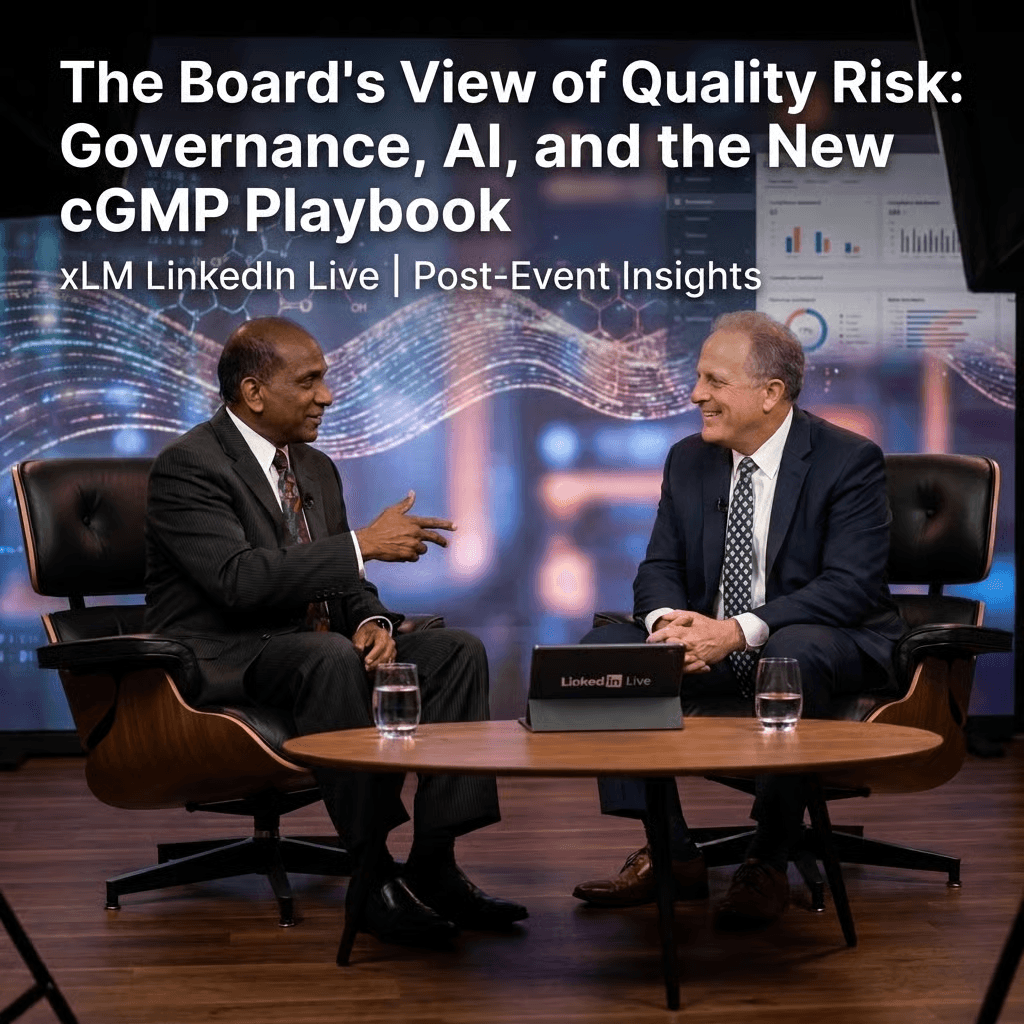
1.0. The Board's View of Quality Risk: Governance, AI, and the New cGMP Playbook
As pharmaceutical and life sciences organizations navigate increasing regulatory complexity, digital transformation, and emerging AI technologies, quality leaders face a new challenge: moving beyond compliance execution and becoming strategic business influencers.
In a recent xLM Continuous Intelligence LinkedIn Live hosted on May 28, 2026, Nagesh Nama sat down with Mike Magee, a seasoned quality and compliance executive with over four decades of leadership experience across pharmaceutical manufacturing, biotechnology, medical devices, and outsourcing facilities.
The event's response showed the topic's urgency:
- 200+ registrations
- 50+ companies represented globally
- Participation from leaders across pharmaceutical operations, regulatory affairs, quality, and digital innovation.
The discussion explored a critical question:
Why does quality risk still struggle to gain the same level of boardroom attention as financial, cybersecurity, and operational risks?
The answer was not simply about compliance systems or regulations. Instead, the conversation highlighted the growing importance of communication, trust, governance, and leadership in shaping the future of quality organizations.
2.0. Event Overview
Mike shared practical lessons from years of leading organizations through regulatory inspections, compliance challenges, quality transformations, and board-level governance discussions.
The conversation covered:
- The communication gap between quality and executive leadership
- Why quality leaders must develop stronger business and marketing skills
- The role of emotional intelligence in quality leadership
- AI's impact on clinical trials and quality operations
- Building trust with regulators
- Quality governance in rapidly growing organizations
- The future of quality culture in the digital age
One message remained consistent throughout the session:
Quality professionals must communicate risk, value, and business impact in a language that executives, boards, and regulators understand.
3.0. Key Takeaways from the Discussion
3.1. The Importance of Marketing Skills in Quality Leadership
Mike shared feedback from a board member: while his technical expertise and leadership capabilities were highly respected, his ability to market the value of quality needed improvement. This challenge affects many quality professionals. Technical knowledge alone often fails to influence executive decisions.
Today's quality leaders must communicate the business value of compliance, explain quality risks in executive terms, and demonstrate how quality contributes to organizational success, growth, and innovation. As companies become increasingly focused on profitability and strategic growth, the ability to advocate for quality in business language is becoming just as important as regulatory expertise.
3.2. Clear Communication and Trust Go Hand in Hand
Mike emphasized that trust is built through communication. Quality professionals often operate in a world of regulatory terminology, deviations, CAPAs, investigations, and compliance metrics, while executives and board members may not be familiar with this language.
Effective leaders simplify complexity and clearly communicate what happened, why it matters, and what action is required. When quality information is presented in a clear, concise, and meaningful manner, it fosters collaboration, strengthens relationships, and builds confidence across the organization. Trust is not established through technical jargon, it is built through clarity, consistency, and transparency.
3.3. Bridging the Gap Between Quality and the Board
The discussion highlighted a common disconnect between quality organizations and the boardroom. While boards routinely evaluate financial risk, operational risk, and cybersecurity risk, quality risk often receives less attention. This gap exists because quality risks are frequently communicated in highly technical language that business leaders find difficult to interpret.
To bridge this divide, quality professionals must understand the broader business context, connect quality metrics to organizational objectives, and focus on communicating outcomes rather than processes. Boards are interested in understanding the impact on business performance, patient safety, reputation, and growth, not lengthy compliance reports. Quality leaders who can make these connections are better positioned to influence strategic decision-making.
3.4. AI in Clinical Trials and the Need for Human Oversight
The conversation explored the growing role of Artificial Intelligence (AI) across life sciences, particularly in clinical development, quality operations, and regulatory oversight. As agencies such as the FDA adopt AI-enabled approaches and real-time data review capabilities, organizations are increasingly evaluating how AI can accelerate decision-making, automate repetitive tasks, and provide continuous monitoring of critical processes.
While AI offers tremendous potential to improve efficiency and manage large volumes of data, human oversight remains essential. Quality professionals will continue to define risk thresholds, establish acceptance criteria, interpret results, and make final decisions. The future is not about replacing people with AI it is about enabling quality leaders to govern intelligent systems while maintaining accountability, oversight, and regulatory compliance.
3.5. Why Boards Often Overlook Quality Risk
One of the most insightful discussions centered around why quality risk often receives less attention than other enterprise risks. Unlike financial or operational events that may appear suddenly, quality risks typically emerge gradually through recurring deviations, supplier oversight gaps, delayed investigations, and ineffective corrective actions. Because these issues develop over time, they can be overlooked until they evolve into significant compliance events, regulatory findings, or business disruptions.
Mike stressed that quality leaders must proactively communicate emerging risks and provide executives with meaningful context before problems escalate. Quality risk should not be viewed solely as a compliance issue it is a strategic business risk that can impact product availability, patient safety, corporate reputation, and long-term business performance.
3.6. Building and Sustaining Quality Culture in the Digital Age
While technology continues to transform the pharmaceutical industry, the discussion reinforced that quality remains fundamentally people-driven. Advanced systems, digital platforms, and AI-powered technologies can improve visibility and enhance decision-making, but they cannot replace the importance of a strong quality culture. Sustainable quality performance depends on accountability, transparency, collaboration, and a commitment to continuous improvement.
Organizations that successfully combine digital transformation with a mature quality culture will be better equipped to adapt to evolving regulatory expectations and operational challenges. As technology becomes increasingly embedded in daily operations, leadership behavior, effective communication, and employee engagement will remain critical drivers of long-term success.
3.7. Communicating Quality by Answering the "So What?" Question
Perhaps the most memorable lesson from the session was Mike's emphasis on answering the "So What?" question. Whether presenting to executives, board members, regulators, or cross-functional teams, quality professionals must move beyond simply reporting data and focus on explaining its significance.
Stakeholders need to understand why an issue matters, what risks it creates, and what actions should be taken. Effective communication requires translating technical findings into meaningful business insights. By consistently answering the "So What?" question, quality leaders can help decision-makers prioritize risks, allocate resources effectively, and understand the true value that quality brings to the organization.
3.8. Building Trust with FDA Investigators
Drawing on decades of regulatory experience, Mike highlighted the importance of building trust with FDA investigators during inspections and regulatory interactions. While inspections are often viewed as formal evaluations of compliance, they also provide an opportunity to demonstrate transparency, ownership, and a commitment to continuous improvement.
Organizations that openly communicate challenges, provide clear responses, and showcase a strong quality culture tend to establish greater credibility with regulators. In today's increasingly digital environment, where data can be reviewed and analyzed more rapidly than ever before, trust remains one of the most valuable assets an organization can build. Earning that trust requires consistency, preparedness, and an unwavering commitment to doing the right thing even when facing difficult decisions.
4.0. Final Thoughts
The pharmaceutical industry is entering a new era where Quality, Governance, Digital Transformation, and Artificial Intelligence (AI) are becoming increasingly interconnected.
The organizations that succeed will not simply implement new technologies. They will build cultures capable of transforming data into decisions, compliance into trust, and quality into competitive advantage.
As Mike Magee noted throughout the discussion, the future of quality leadership is not just about understanding regulations. It is about influencing decisions, communicating risk, building relationships, and creating trust across every level of the organization.
5.0. Continue the Conversation
At xLM Continuous Intelligence, we believe the future of pharmaceutical manufacturing lies at the intersection of Continuous Intelligence, Quality Governance, and Responsible AI.
As organizations navigate increasingly complex regulatory, operational, and business challenges, the ability to continuously monitor risk, strengthen compliance, and accelerate decision-making will define the next generation of industry leaders.
Follow xLM for more conversations with industry experts shaping the future of quality, compliance, manufacturing, digital transformation, and AI-powered operations.
6.0. About our Guest
Michael Magee
Quality, Regulatory & Board Advisor
Mike Magee is a distinguished quality, compliance, and governance advisor with more than 40 years of experience across pharmaceutical manufacturing, biotechnology, medical devices, compounding pharmacies, and outsourcing facilities.
As Principal Consultant at Conformat Solutions LLC, Mike advises executive teams, boards, and quality organizations on cGMP compliance, regulatory strategy, quality culture, governance, and operational excellence.
His unique perspective bridges shop-floor realities, executive leadership expectations, and regulatory requirements, helping organizations transform quality from a compliance obligation into a strategic business advantage.
Connect with Michael on LinkedIn
7.0. About our Host
Nagesh Nama
CEO, xLM Continuous Intelligence | Founder, ValiMation
Nagesh is a pioneer in AI/ML-driven GxP compliance with nearly three decades of experience helping pharmaceutical, biotech, and medical device companies navigate validation, data integrity, and regulatory compliance. He is the founder and CEO of both ValiMation (founded 1996) and xLM Continuous Intelligence — the company that first introduced a Continuous Validation platform supporting IaaS/PaaS/SaaS environments compliant with 21 CFR Part 11 and Annex 11. Today, xLM offers a comprehensive suite of continuously validated AI/ML managed services spanning intelligent validation (cIV), predictive maintenance, temperature mapping, and GxP AI agents. Nagesh is a member of the Forbes Technology Council and the Fast Company Executive Board, a contributor to Forbes and Fast Company, and has been featured on Microsoft's AI Agents Vlog. He holds an M.S. in Manufacturing Engineering from the University of Massachusetts, Amherst.
About the Author

About Nagesh Nama
Nagesh Nama is the Founder and CEO of xLM Continuous Intelligence and ValiMation, bringing nearly 30 years of experience in AI-driven GxP compliance, computer system validation, and regulatory technology for the life sciences industry. A recognized thought leader, he pioneered the industry's first Continuous Validation platform supporting compliant IaaS, PaaS, and SaaS environments under 21 CFR Part 11 and Annex 11. His work focuses on advancing intelligent validation, AI-powered compliance, predictive maintenance, temperature mapping, and GxP AI agents to help pharmaceutical, biotechnology, and medical device organizations accelerate digital transformation while maintaining continuous compliance. Nagesh is a member of the Forbes Technology Council and the Fast Company Executive Board, a contributor to Forbes and Fast Company, and has been featured by Microsoft for his work in AI agents.