Future of AI in Pharmaceutical Manufacturing | xLM
Discover the future of AI in pharmaceutical manufacturing with ContinuousOS enabling governed AI, continuous validation, GxP compliance, and trusted innovation.
1.0. Introduction
Artificial Intelligence (AI) has entered a new phase. In recent years, organizations have focused on identifying the best Large Language Models (LLMs), experimenting with AI copilots, and launching AI proof-of-concepts (PoCs). While these initiatives demonstrate AI's tremendous potential, they also reveal a fundamental truth: technology alone does not transform an organization.
For pharmaceutical manufacturing, this reality is even more significant. Within highly regulated GxP environments, every AI-driven decision must be transparent, validated, traceable, and inspection-ready. Success is determined not by how quickly AI can generate content, but by how confidently an organization can demonstrate regulatory compliance while accelerating innovation. The real question is no longer simply, "Can the model answer?" It is, "Can the organization defend the answer?"
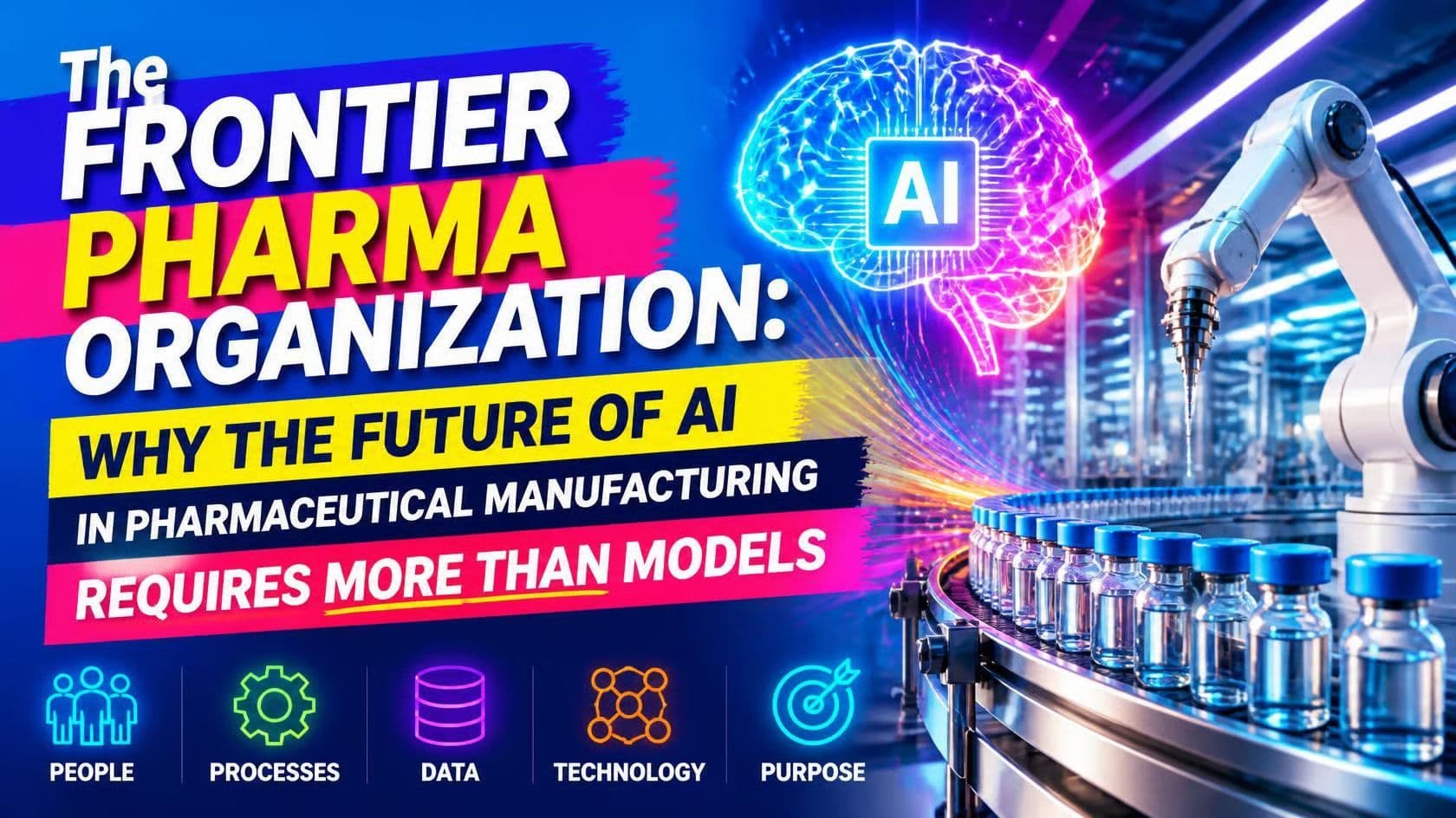
At xLM Continuous Intelligence, we believe the future belongs to the Frontier Pharma Organization, an enterprise where governed AI agents work alongside people to continuously improve manufacturing, quality, validation, engineering, and compliance without compromising patient safety. This future is powered by ContinuousOS, the operating foundation for trusted AI in regulated manufacturing.
The opportunity is enormous. The challenge is equally significant. Pharmaceutical manufacturers must move beyond isolated experimentation and establish an operating model where Artificial Intelligence becomes a controlled, auditable, and scalable enterprise capability embedded into everyday operations.
2.0. Why Pharmaceutical Manufacturing Needs a Different AI Strategy
Life sciences manufacturers have increasingly begun adopting Artificial Intelligence across documentation, quality management, predictive maintenance, validation, regulatory affairs, and manufacturing operations. Yet despite this growing adoption, many initiatives fail to progress beyond pilot programs.
The reason is straightforward. Traditional enterprise AI strategies primarily focus on deploying models. Pharmaceutical manufacturing, however, requires an entire ecosystem that supports AI throughout its operational lifecycle while simultaneously satisfying stringent regulatory requirements.
Every AI-enabled process in regulated environments must be built on trust, transparency, and accountability. Organizations need complete visibility into how an AI-generated recommendation was produced, what data and reasoning influenced the outcome, whether the output can be validated, who reviewed and approved it, whether every action is captured within a comprehensive audit trail, and whether the supporting evidence can withstand regulatory inspection. Beyond deployment, AI systems must be continuously governed to ensure that model updates, process changes, and evolving business requirements never compromise compliance, quality, or patient safety.
These are not theoretical considerations they are practical necessities within regulated industries where data integrity, traceability, and accountability are non-negotiable. An AI model that improves efficiency but cannot be explained, reviewed, or validated creates regulatory exposure, not business value.
Pharmaceutical manufacturers also operate within a uniquely interconnected ecosystem. Their operations span Quality Management Systems (QMS), Manufacturing Execution Systems (MES), Laboratory Information Management Systems (LIMS), Enterprise Resource Planning (ERP), Computerized Maintenance Management Systems (CMMS), document management platforms, and validation workflows. AI cannot operate independently from this ecosystem and still remain effective. It must integrate seamlessly, understand operational context, respect established controls, and function within the organization's overall governance framework.
Without these controls and clear governance, AI introduces operational and regulatory risk rather than delivering business value. The true challenge is not simply adopting AI; it is adopting AI responsibly.

3.0. The Rise of the Frontier Pharma Organization
The concept of the Frontier Company recognizes that meaningful transformation requires much more than software deployment. It demands entirely new operating models where intelligent systems become embedded throughout every business function.
At xLM, we believe pharmaceutical manufacturers require a specialized evolution. The Frontier Pharma Organization envisions AI as a fully governed operational capability spanning the entire GxP ecosystem. Instead of relying on isolated AI assistants, organizations deploy specialized intelligent agents across critical business functions, including validation engineering, quality assurance, manufacturing operations, maintenance, calibration, environmental monitoring, regulatory affairs, supplier quality, deviation management, CAPA, training, and engineering documentation.
Each intelligent agent performs a highly specialized role while operating within a unified governance framework that ensures transparency, compliance, and accountability. This architecture enables scalability because a validation agent serves a fundamentally different purpose than a quality agent, and a quality agent differs from a maintenance agent. Although each specializes in a unique domain, every agent shares common enterprise controls, evidence standards, and approval workflows.
Within this model, AI evolves beyond simple automation to become an enterprise-wide capability. The Frontier Pharma Organization amplifies human expertise by giving subject matter experts (SMEs) greater leverage, reducing repetitive work, and creating a far more responsive operating model. As one guiding principle emphasizes:
The goal is not to automate people out of the process; it is to remove friction from the process
This distinction is especially important. In regulated pharmaceutical manufacturing, the most effective AI strategy is not the one that simply moves the fastest, it is the one that enables organizations to move faster while maintaining unwavering alignment with quality, regulatory compliance, and patient safety.

4.0. From Standalone AI Tools to AI Operating Systems
Many organizations start AI adoption with isolated tools for documentation, quality review, predictive analytics, or knowledge management. While these improve productivity in departments, they create fragmented AI ecosystems with inconsistent governance and limited interoperability.
As AI use grows, organizations need a unified framework to orchestrate AI across multiple regulated processes.
This need drives the concept of an AI Operating System. Instead of another AI application, it provides infrastructure to manage intelligent agents, orchestrate workflows, enforce governance, monitor models, and maintain compliance enterprise-wide.
For regulated industries, this embeds governance, validation, security, and auditability into the architecture, enabling scalable AI with regulatory confidence.
An example is ContinuousOS, by xLM-continuous intelligence, a compliance-first AI Operating System for regulated GxP environments.
5.0. ContinuousOS: The Operating System for the Frontier Pharma Organization
Building a true Frontier Pharma Organization requires much more than deploying advanced AI models. It demands an operating framework capable of orchestrating intelligent agents while maintaining continuous compliance across the enterprise.
This vision becomes reality through ContinuousOS. Acting as the enterprise governance layer, ContinuousOS connects AI agents, enterprise systems, quality processes, and regulatory controls into a single, unified operating platform. Rather than treating AI as another standalone application, ContinuousOS manages AI as a continuously governed enterprise capability purpose-built for AI-driven GxP operations.
The platform delivers comprehensive capabilities, including AI governance, policy enforcement, human-in-the-loop orchestration, continuous validation workflows, integrated audit readiness, enterprise-wide traceability, agent lifecycle management, regulatory documentation automation, and operational intelligence across the entire GxP ecosystem.
ContinuousOS serves as the control plane for regulated AI. It ensures every intelligent agent operates within approved boundaries, records every action, makes every recommendation reviewable, and links every output to supporting evidence. By integrating directly with the systems where regulated work occurs including quality events, maintenance activities, validation packages, and regulatory documentation. ContinuousOS embeds governance directly into daily operations.
This foundation enables pharmaceutical manufacturers to confidently scale AI across the enterprise. ContinuousOS is not a chatbot or a point solution, it is the operating system that makes governed AI practical, scalable, and usable in real-world regulated manufacturing.

6.0. Building the Frontier Organization Through Continuous Intelligence
Technology by itself cannot create an intelligent enterprise. Lasting transformation requires the seamless integration of people, processes, governance, and intelligent automation into a unified operating model.
At xLM, we enable this transformation through ContinuousOS. By bringing together strategy, engineering, validation, and governance, ContinuousOS empowers pharmaceutical manufacturers to move beyond isolated AI experiments toward sustainable, enterprise-wide AI adoption.
This is not about introducing another software platform. It is about creating a trusted operating system for regulated innovation. Achieving this transformation requires a fundamental shift in mindset. Rather than asking, "What can AI do?", leaders must begin asking, "What operating model enables AI to create value safely?" This changes the conversation from novelty to discipline, from experimentation to enterprise scale, and from isolated use cases to long-term organizational capability.
As many transformation leaders have observed:
The most advanced AI strategy is still a people strategy
The success of AI in pharmaceutical manufacturing depends just as much on training, organizational adoption, governance, and cross-functional collaboration as it does on the performance of AI models themselves.
7.0. An Intelligent Workforce for Every Function
Tomorrow's pharmaceutical manufacturer will not rely on a single enterprise chatbot. Instead, organizations will deploy an ecosystem of intelligent digital workers, each designed to address specialized operational challenges across the enterprise.
Imagine a connected workforce where ContinuousOS orchestrates validation, quality review, manufacturing support, maintenance intelligence, environmental monitoring, and regulatory documentation within a coordinated and governed operating model.
Validation agents generate User Requirement Specifications (URS), risk assessments, traceability matrices, IQ/OQ/PQ protocols, and comprehensive validation reports. Quality agents analyze deviations, recommend investigations, identify emerging trends, and support Corrective and Preventive Action (CAPA) execution.
Manufacturing agents monitor production activities, optimize operational workflows, and provide contextual recommendations that assist operators in real time. Predictive maintenance agents continuously evaluate equipment health, detect anomalies, and help prevent unplanned downtime before failures occur.
Environmental monitoring agents continuously assess facility conditions, identify environmental excursions, and automatically initiate corrective workflows when required. Regulatory intelligence agents prepare inspection-ready documentation while maintaining complete traceability across regulated processes.
The value of this operating model extends far beyond speed alone. It establishes consistency by standardizing how work is initiated, reviewed, approved, and documented throughout the enterprise. It also preserves valuable institutional knowledge, ensuring expertise is always available exactly where and when it is needed.
These intelligent agents are designed to collaborate with human experts and not replace them. Their purpose is to amplify human expertise while ensuring every recommendation remains explainable, every action is logged, and every approval is fully visible. The result is a workforce that is not only more intelligent but also fundamentally trustworthy.

8.0. Continuous Compliance for an AI-Driven Enterprise
Traditionally, validation has been treated as a project that concludes before production begins. Artificial Intelligence fundamentally changes this assumption. AI models evolve, business processes evolve, enterprise applications evolve, and regulatory expectations continue to evolve.
As a result, compliance must become continuous, rather than remaining a one-time milestone. As AI models, enterprise applications, and business processes change over time, organizations require a framework that supports continuous validation, continuous governance, continuous monitoring, continuous documentation, and continuous improvement. This ongoing approach ensures that AI systems remain trustworthy, compliant, and inspection-ready throughout their lifecycle, enabling pharmaceutical manufacturers to innovate with confidence while maintaining the highest standards of quality, regulatory compliance, and patient safety.
This philosophy is embedded within ContinuousOS. The platform enables organizations to maintain control, traceability, and audit readiness as AI becomes an integral part of daily GxP operations. The objective extends far beyond deploying AI, it is to ensure that AI remains trustworthy, explainable, and inspection-ready throughout its operational lifecycle.
This capability becomes increasingly important as models are retrained, prompts are updated, workflows evolve, or new data sources are introduced. Every change has the potential to influence system behavior. Continuous compliance ensures that these changes are properly assessed, documented, governed, and controlled rather than being left to chance. Within the Frontier Pharma Organization, compliance is no longer a checkpoint it becomes a living organizational capability.
9.0. The xLM Vision: Building the Frontier Pharma Organization
The pharmaceutical industry stands at a defining moment. The organizations that will lead the next decade are not simply those that adopt Artificial Intelligence, but those that build intelligent enterprises where humans and governed AI agents work together to continuously improve manufacturing, quality, engineering, and compliance.
This transformation requires far more than advanced algorithms or increasingly powerful AI models. It demands deep domain expertise, validated and compliant processes, robust governance, operational excellence, and an unwavering commitment to quality and patient safety. Only by bringing these elements together can pharmaceutical manufacturers build AI-enabled organizations that innovate with confidence while consistently meeting the rigorous expectations of regulators and maintaining stakeholder trust.
At xLM Continuous Intelligence, we are building that future today. By combining AI engineering, continuous validation, governance, and extensive GxP expertise, we help pharmaceutical manufacturers move beyond isolated AI pilots toward a fully operational Frontier Pharma Organization, where innovation and compliance advance together.
Our vision is both simple and ambitious: to help regulated manufacturers adopt AI in a way that is practical, defensible, and scalable. This means designing AI systems that fit naturally within pharmaceutical operations rather than forcing pharmaceutical operations to adapt to generic AI technologies.
10.0. Conclusion
The future of pharmaceutical manufacturing will not be determined by the largest AI model or the fastest automation platform. Instead, it will be defined by organizations that successfully integrate Artificial Intelligence into every aspect of their operations while preserving the highest standards of quality, regulatory compliance, and trust.
The Frontier Pharma Organization represents this next stage of evolution. It is a future where intelligent agents support every business function, governance is embedded into every decision, validation becomes continuous, and innovation never comes at the expense of patient safety.
At xLM Continuous Intelligence, we do more than help organizations deploy AI. We help build the Frontier Pharma Organization, a future where ContinuousOS serves as the trusted operating system powering the next generation of regulated pharmaceutical manufacturing.
Ready to Learn More About xLM Continuous Intelligence?
About the Authors

About Nagesh Nama
Nagesh Nama is the Founder and CEO of xLM Continuous Intelligence and ValiMation, bringing nearly 30 years of experience in AI-driven GxP compliance, computer system validation, and regulatory technology for the life sciences industry. A recognized thought leader, he pioneered the industry's first Continuous Validation platform supporting compliant IaaS, PaaS, and SaaS environments under 21 CFR Part 11 and Annex 11. His work focuses on advancing intelligent validation, AI-powered compliance, predictive maintenance, temperature mapping, and GxP AI agents to help pharmaceutical, biotechnology, and medical device organizations accelerate digital transformation while maintaining continuous compliance. Nagesh is a member of the Forbes Technology Council and the Fast Company Executive Board, a contributor to Forbes and Fast Company, and has been featured by Microsoft for his work in AI agents.