
AI Agents in GxP Manufacturing: A Competitive Necessity
Discover why GxP manufacturers must adopt AI agents to improve compliance, operational efficiency, continuous intelligence, and manufacturing agility.

1.0. Manufacturing’s Unexpected AI Leadership
The rise of AI agents is no longer a future possibility, it is rapidly transforming enterprises. Recent data reveals a surprising shift: while early AI agent adoption was expected mainly in customer service, IT, and digital operations, manufacturing has emerged as a leading sector in enterprise deployment.
This marks a critical turning point. Nearly one in five organizations across industries operationalize AI agents, with manufacturing accelerating experimentation in autonomous and semi-autonomous systems. This reflects recognition that manufacturing environments with complex workflows, repeatable execution, structured data streams, and high operational precision are ideal for agent-driven automation.
This leadership shows forward-looking manufacturers view AI agents not just as automation tools but as intelligent collaborators transforming operational decisions. From orchestrating workflows to identifying deviations, recommending corrections, and autonomously triggering tasks, these agents form a new operational layer. However, while manufacturing overall accelerates, GxP-regulated manufacturing remains an exception, constrained by legacy systems, strict validation requirements, and risk-averse models that slow adoption.

2.0. Why GxP Manufacturing Is Lagging Behind
Despite manufacturing's AI leadership, GxP manufacturing trails behind. This stems from structural complexity, not lack of opportunity. Pharmaceutical and life sciences manufacturing operate in tightly regulated environments where every process, decision, and system interaction must meet strict traceability, validation, compliance, and auditability standards.
Traditional digital transformation efforts focus on digitizing workflows rather than reimagining them. Systems like MES, QMS, LIMS, and validation platforms improve recordkeeping and visibility but still rely heavily on manual intervention, siloed decisions, and human-driven exception handling. Batch record reviews require extensive manual scrutiny. Deviations demand labor-intensive investigations. Validation cycles remain document-heavy and slow. Change control often moves too slowly for modern needs.
Hesitation to introduce autonomous systems into validated environments adds to the challenge. Organizations question whether AI agents can provide sufficient transparency, explainability, and control to meet regulatory standards. Many GxP manufacturers remain caught between the need for innovation and fear of compliance risks.
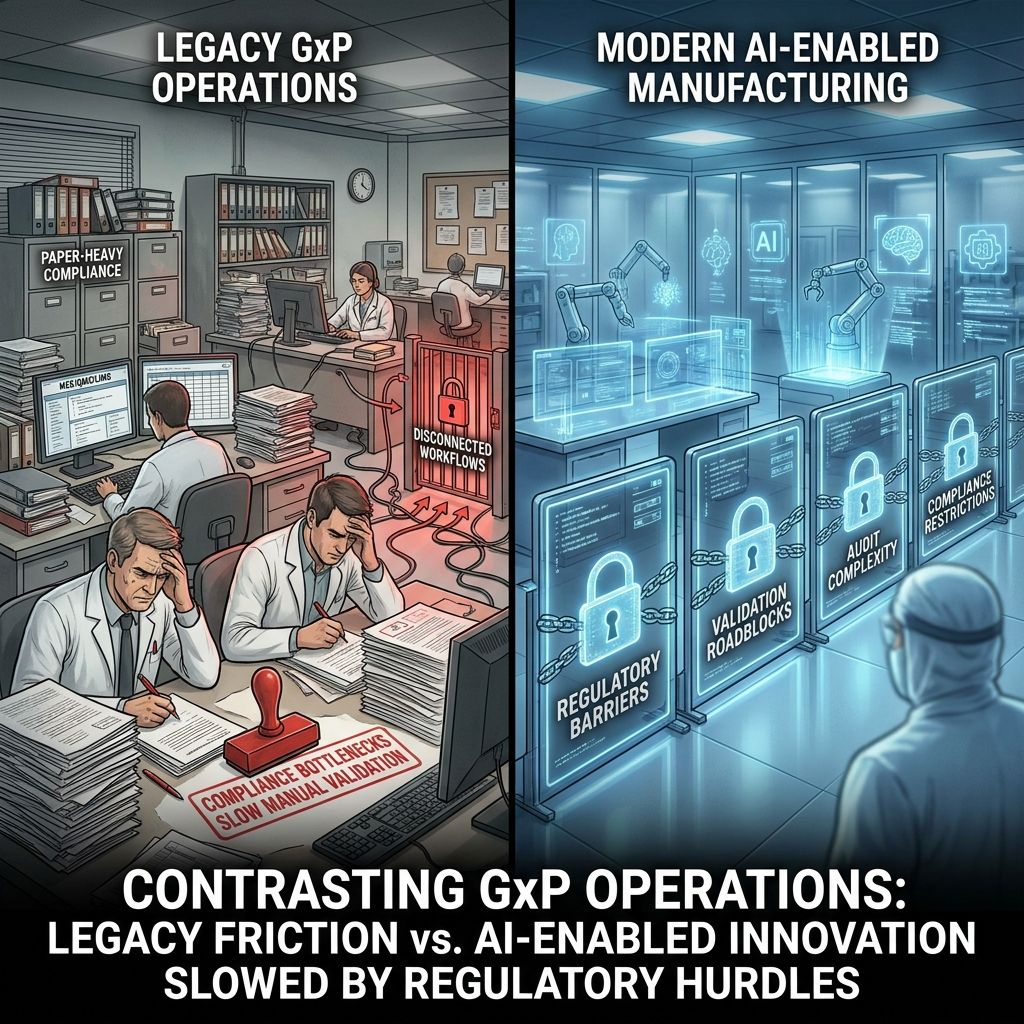
ContinuousOS Brings Agentic AI to GxP Manufacturing
3.0. Why GxP Manufacturing Must Adopt AI Agents Now
The urgency for AI agent adoption in GxP manufacturing is greater than ever. Pharmaceutical manufacturing faces mounting pressures: speed to market, operational resilience, supply chain volatility, regulatory complexity, and rising costs.
Manual workflows no longer scale. Every hour spent on repetitive verification, manual reconciliation, exception routing, document reviews, and procedural tasks drags on efficiency. More importantly, manual processes increase variability, human error risk, and delay responses when speed is critical.
AI agents enable continuous operational intelligence. They monitor workflows in real time, detect anomalies early, execute pre-approved tasks autonomously, and offer contextual recommendations based on historical and live data. This cuts cycle times while improving consistency, compliance, and precision.
For GxP organizations, AI agents augment human expertise, freeing skilled teams from repetitive tasks to focus on strategic quality oversight, innovation, and higher-value decisions. Delaying this transition risks falling behind competitors embedding intelligence into operations.
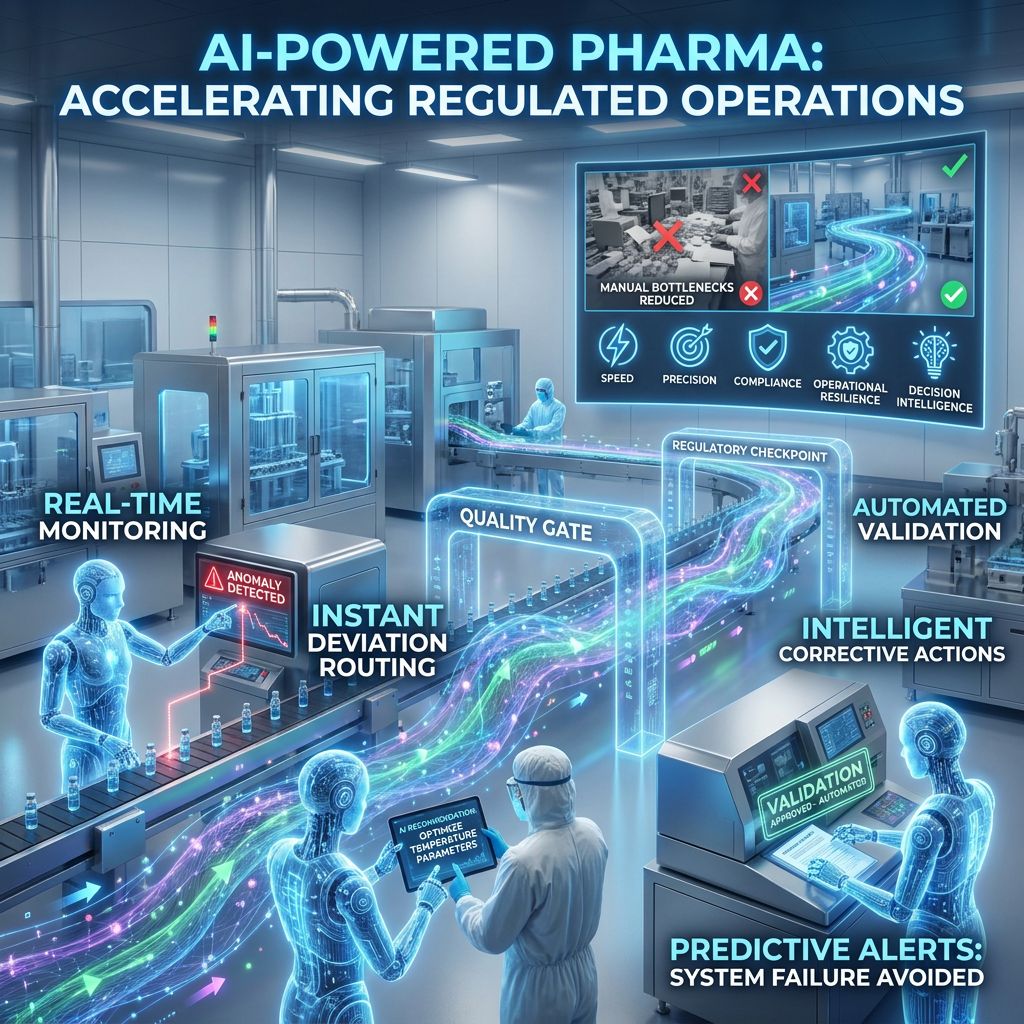
4.0. Enter ContinuousOS: The Operating System for GxP Agent Adoption
As GxP manufacturing faces growing operational complexity, regulatory scrutiny, and delivery pressures, it needs more than isolated automation tools. It requires an integrated intelligence layer embedding compliance, decision-making, and execution into regulated workflows. This is where ContinuousOS by xLM becomes essential.
ContinuousOS is a compliance-first, AI-native operating system built for regulated pharmaceutical manufacturing. Unlike platforms focusing on digitizing manual tasks, ContinuousOS creates a unified framework where autonomous AI agents execute GxP workflows with built-in traceability, auditability, governance, and scalability.
At its core, ContinuousOS uses composable GxP primitives: modular building blocks automating workflows across manufacturing, validation, quality, compliance, and governance. These combine AI-powered content generation, robotic process automation (RPA), autonomous software validation, predictive analytics, continuous monitoring, and intelligent vendor audit orchestration into an adaptive compliance ecosystem.
The platform integrates specialized agents including URS Agent, Validation Plan Agent, Test Script Agent, TraceMatrix Agent, Browser Validation Agent, Desktop Validation Agent, Mobile Validation Agent, Predictive Maintenance Agent, Continuous Temperature Mapping Agent, Environmental Monitoring Agent, and Vendor Audit Agent. Together, these agents shift organizations from post-execution evidence generation to compliance embedded in operational execution.
ContinuousOS moves GxP operations from reactive compliance management to continuous intelligence-driven manufacturing execution.
5.0. How ContinuousOS Works
ContinuousOS operates via a coordinated ecosystem of specialized autonomous AI agents addressing key workflows in regulated pharmaceutical manufacturing. These agents work within a governed orchestration framework that interprets enterprise data, executes approved actions, generates compliant evidence, and supports intelligent operational decisions.
In documentation and software validation, ContinuousOS transforms resource-intensive GxP operations. Agents like the URS Agent, Validation Plan Agent, Test Script Agent, and TraceMatrix Agent autonomously generate regulator-aligned documentation by interpreting manuals, SOPs, system configurations, transcripts, recordings, and procedural artifacts. This reduces manual effort while improving consistency, traceability, and audit readiness.
Execution-focused agents such as the Browser Validation Agent, Desktop Validation Agent, and Mobile Validation Agent modernize software qualification by replacing screenshot-heavy CSV processes with autonomous execution. These agents run validation scripts, capture tamper-proof evidence, generate audit-ready reports, and maintain continuous regression validation as systems evolve. This shifts organizations from periodic validation to continuous validation intelligence, cutting cycle times from weeks to under 24 hours.
Beyond validation, ContinuousOS extends into predictive manufacturing intelligence. The Predictive Maintenance Agent analyzes equipment data across SCADA and PLC systems to forecast failures before production impact. The Continuous Temperature Mapping Agent monitors storage and qualification chambers in real time, generating automated compliance reports. The Environmental Monitoring Agent evaluates temperature, humidity, pressure, and particulates to identify contamination risks proactively.
ContinuousOS enhances external quality governance via its Vendor Audit Agent, powered by xLM’s Continuous Intelligent GxP Auditor (cIGA). Built on a multi-agent architecture with Manager, Auditor, and Validator Agents, it conducts AI-led interviews, validates vendor evidence in real time, scores compliance maturity automatically, and generates regulator-ready audit reports. This transforms vendor oversight from periodic manual tasks into continuous compliance intelligence.
Through this agent ecosystem, ContinuousOS creates an always-on intelligence layer that learns, adapts, monitors, and executes across GxP manufacturing environments. Predictive manufacturing intelligence and continuous monitoring
ContinuousOS extends automation beyond documentation and validation into manufacturing.
It includes Predictive Maintenance Agents, Continuous Temperature Mapping (cTM), and Environmental Monitoring Agents that analyze operational data continuously across regulated environments.
These agents turn manufacturing into predictive operational ecosystems that identify risks before they affect quality or compliance.
Predictive Maintenance Agents use machine learning with SCADA and PLC systems to forecast failures and reduce downtime. Continuous Temperature Mapping monitors storage and chambers, generating qualification reports. Environmental Monitoring analyzes humidity, pressure, temperature, and particles to prevent contamination and ensure compliance.
These features are vital as pharma pursues Industry 4.0 and AI-driven smart manufacturing.
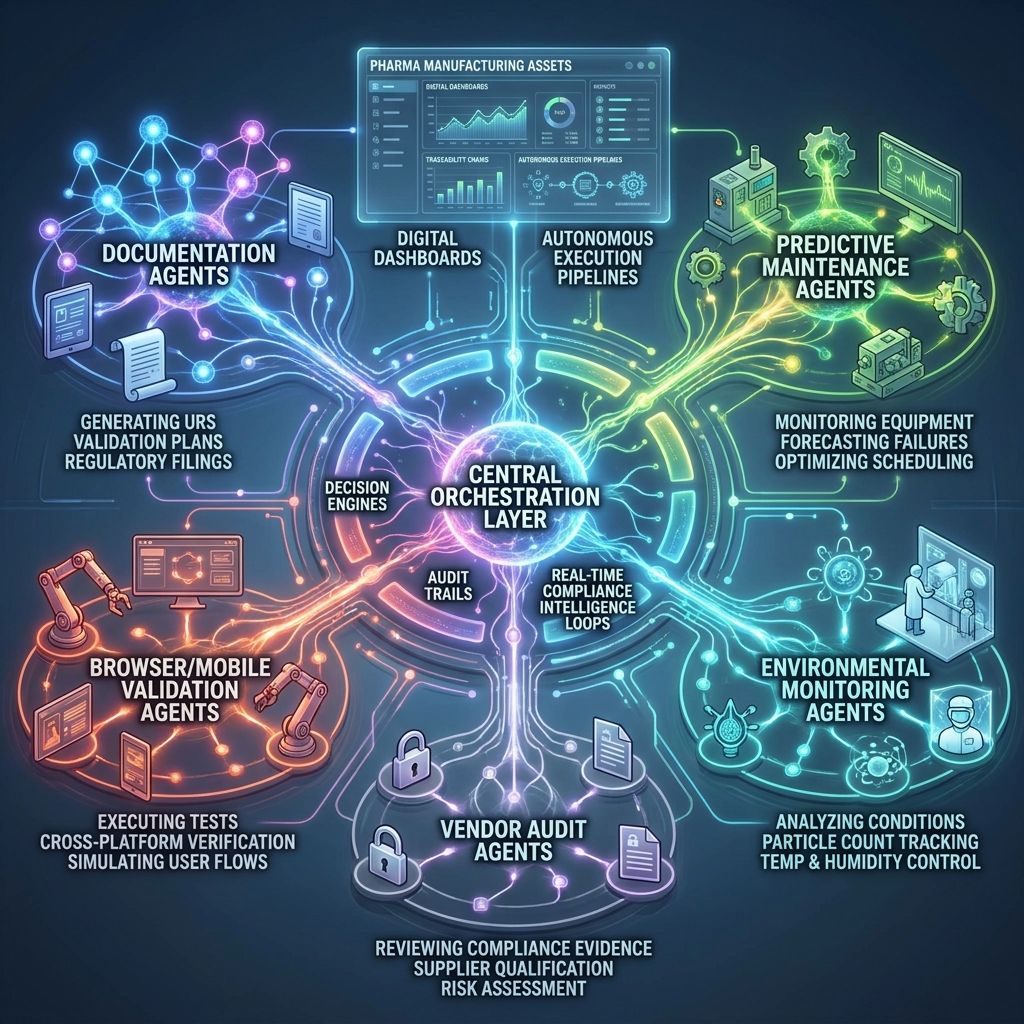
ContinuousOS Powers AI-Native GxP Operations
6.0. The ContinuousOS Advantage
ContinuousOS’s true advantage lies in combining advanced autonomous intelligence with GxP-grade governance and regulatory trust. Unlike generic AI platforms, ContinuousOS is engineered for highly regulated pharmaceutical operations where every action must be explainable, traceable, and defensible.
Its architecture embeds continuous compliance directly into workflows, making evidence generation, auditability, and governance native to every automated task. This shifts organizations from reactive documentation to proactive, continuously assured operational control.
ContinuousOS reduces operational burden by automating document generation, validation, predictive monitoring, and vendor audits. It lowers manual effort, minimizes repetitive GDP errors, and speeds execution across validation and manufacturing lifecycles. Tasks once requiring weeks of SME time now complete within hours, maintaining regulatory rigor.
Another key advantage is scalable modular adoption. Organizations can start with targeted deployments like validation automation, predictive maintenance, or vendor audit intelligence, then expand agent use across manufacturing. This phased approach reduces risk and delivers quick business value.
Most importantly, ContinuousOS enables pharmaceutical organizations to move from fragmented digital initiatives to a truly AI-native operational model. It transforms disconnected systems into a unified intelligence fabric that orchestrates workflows, governs AI decisions, generates compliant evidence at scale, and supports continuous, predictive, autonomous GxP operations.
ContinuousOS is not just another automation platform, it is the foundational operating system for the future of agentic pharmaceutical manufacturing.
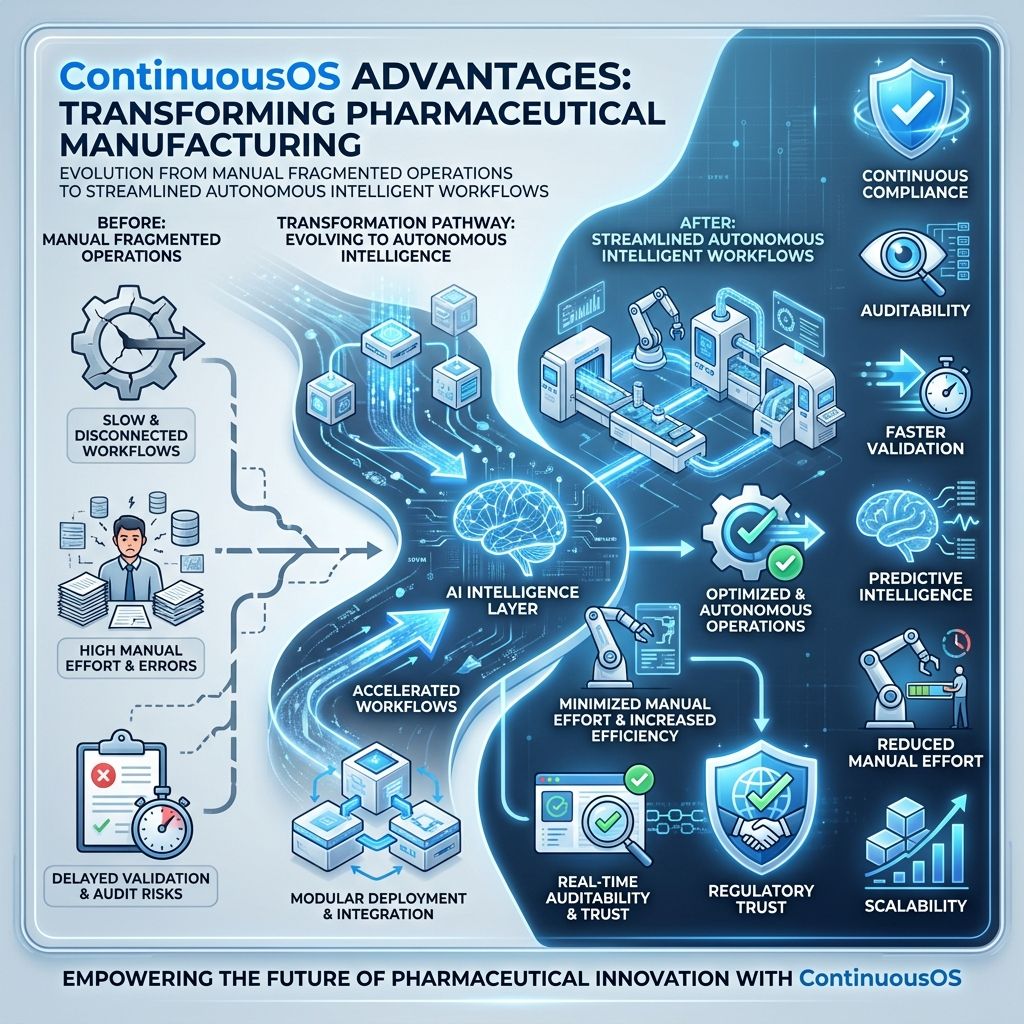
7.0. The Future of GxP Manufacturing Is Agentic
Manufacturing’s leadership in AI agent adoption signals a profound shift in industrial operations. For GxP manufacturers, the question is no longer if agentic systems will become central, but how quickly they can adopt them responsibly.
The future favors manufacturers combining regulatory rigor with intelligent autonomy. Those who succeed will operate with greater speed, adaptability, and precision while maintaining strict compliance.
ContinuousOS embodies that future. It provides the foundation for regulated manufacturers to move beyond static digitization into continuous intelligence, autonomous collaboration, and adaptive execution.
The next era of GxP manufacturing won’t be defined by more dashboards, workflows, or manual reviews. It will be defined by intelligent agents working continuously alongside human expertise to deliver faster, smarter, and more compliant outcomes.
About the Authors

About Nagesh Nama
Nagesh Nama is the Founder and CEO of xLM Continuous Intelligence and ValiMation, bringing nearly 30 years of experience in AI-driven GxP compliance, computer system validation, and regulatory technology for the life sciences industry. A recognized thought leader, he pioneered the industry's first Continuous Validation platform supporting compliant IaaS, PaaS, and SaaS environments under 21 CFR Part 11 and Annex 11. His work focuses on advancing intelligent validation, AI-powered compliance, predictive maintenance, temperature mapping, and GxP AI agents to help pharmaceutical, biotechnology, and medical device organizations accelerate digital transformation while maintaining continuous compliance. Nagesh is a member of the Forbes Technology Council and the Fast Company Executive Board, a contributor to Forbes and Fast Company, and has been featured by Microsoft for his work in AI agents.