ContinuousOS in Sync with Google's Agentic AI Vision
ContinuousOS aligns with Google’s Agentic AI vision to deliver governed autonomy, compliance, audit-ready AI, and controlled learning for GxP enterprises.
1.0. Introduction
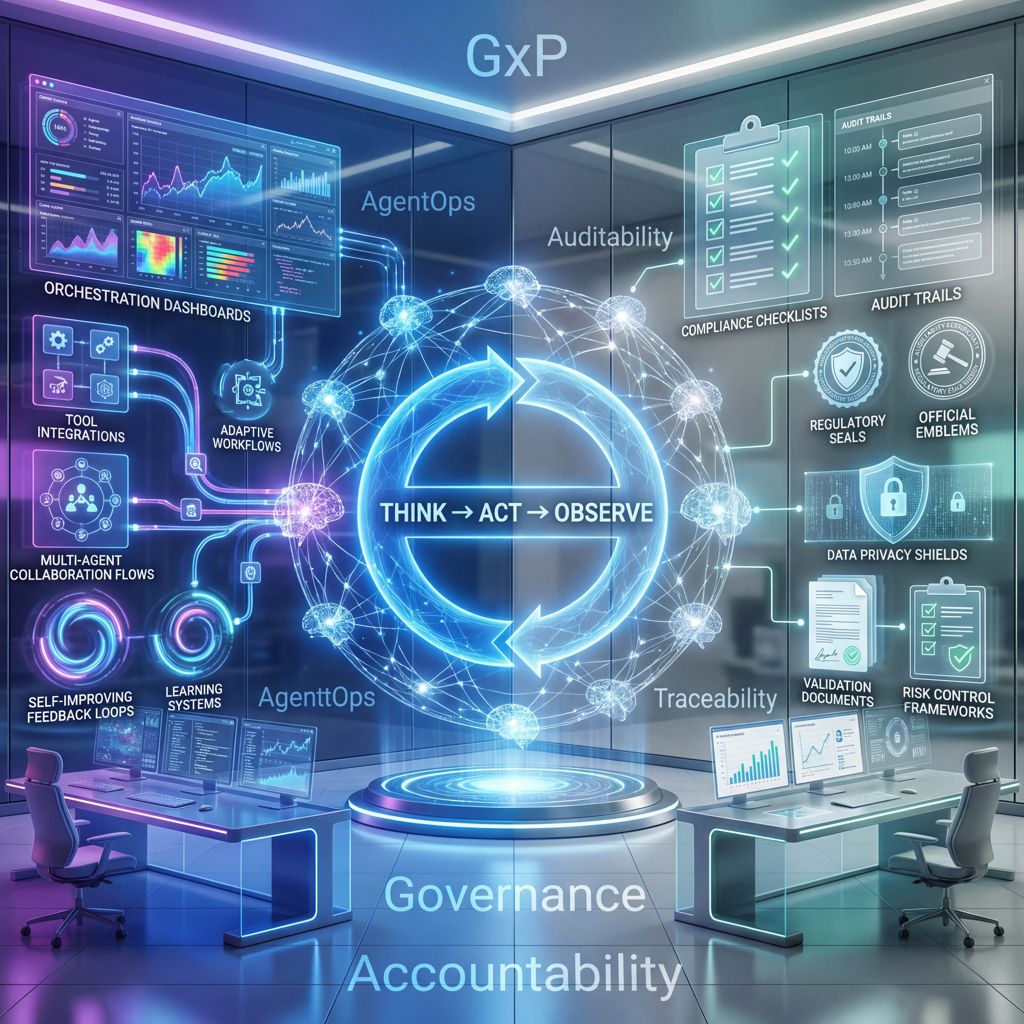
The recent release of Google's agentic AI documentation marks a milestone in how the industry views autonomous systems. The document presents agents not merely as prompt-driven bots but as complete software systems capable of reasoning, acting, orchestrating tools, and operating within an agentic loop of “Think → Act → Observe” (@Google AI for Developers, Google Gemini 3 Flash Automates Visual Tasks with Think-Act-Observation Loop | Google AI for Developers posted on the topic | LinkedIn). It introduces architectural patterns for orchestration, multi-agent collaboration, AgentOps, and self-improving systems, laying the foundation for scalable, production-grade autonomy.
This vision is compelling. But as enterprises move from experimentation to deployment, especially in life sciences, the gap between architectural aspiration and operational reality grows.
Autonomous systems face constraints that architectural frameworks alone cannot address:
- Regulatory compliance and auditability
- Data privacy and validation barriers
- Continuous oversight requirements
- Explainability and traceability mandates
- Risk of compounding errors in multi-agent ecosystems
In dynamic, compliance-heavy environments, autonomy requires governance. The conversation must evolve from agentic capability to agentic accountability.
2.0. Agent Definition & Autonomy: Vision vs Operational Robustness
Google’s documentation defines agents as complete software systems that reason, act, and orchestrate tools to achieve goals. This shifts focus from isolated LLM interactions to structured autonomy.
However, real-world deployments reveal a critical limitation. In regulated domains, robust autonomy faces compliance boundaries.
Few agentic architectures today demonstrate:
- Reliable self-adaptation in live production
- Controlled evolution within regulatory guardrails
- Consistent behavior across high-risk contexts
Autonomy in pharma or GxP manufacturing means bounded intelligence with accountable decision paths (@The Theta Techno Labs, Governance and Compliance Challenges of Agentic AI in Regulated Industries).
2.1. How ContinuousOS + Human-in-the-Loop (HITL) solves this
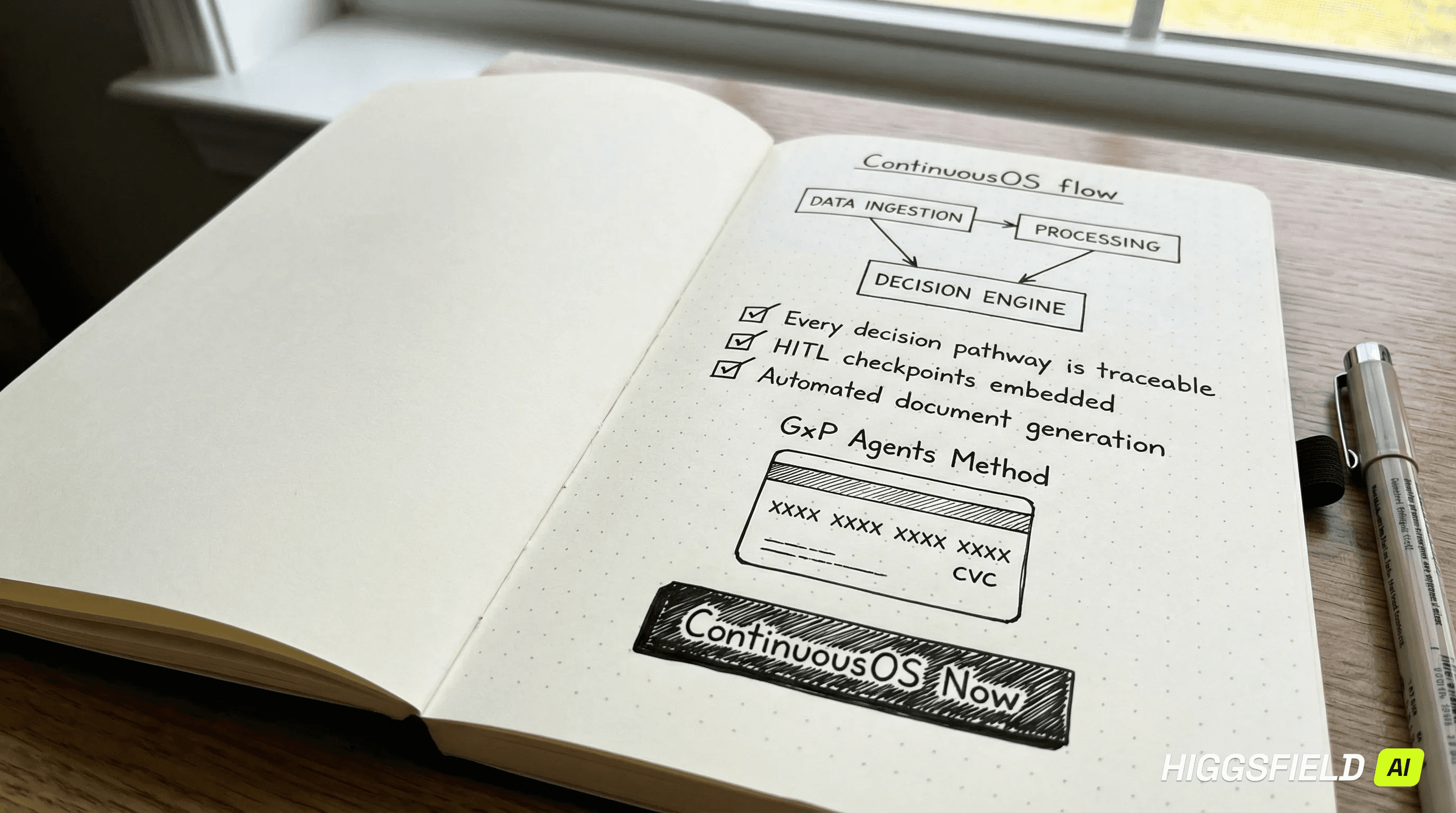
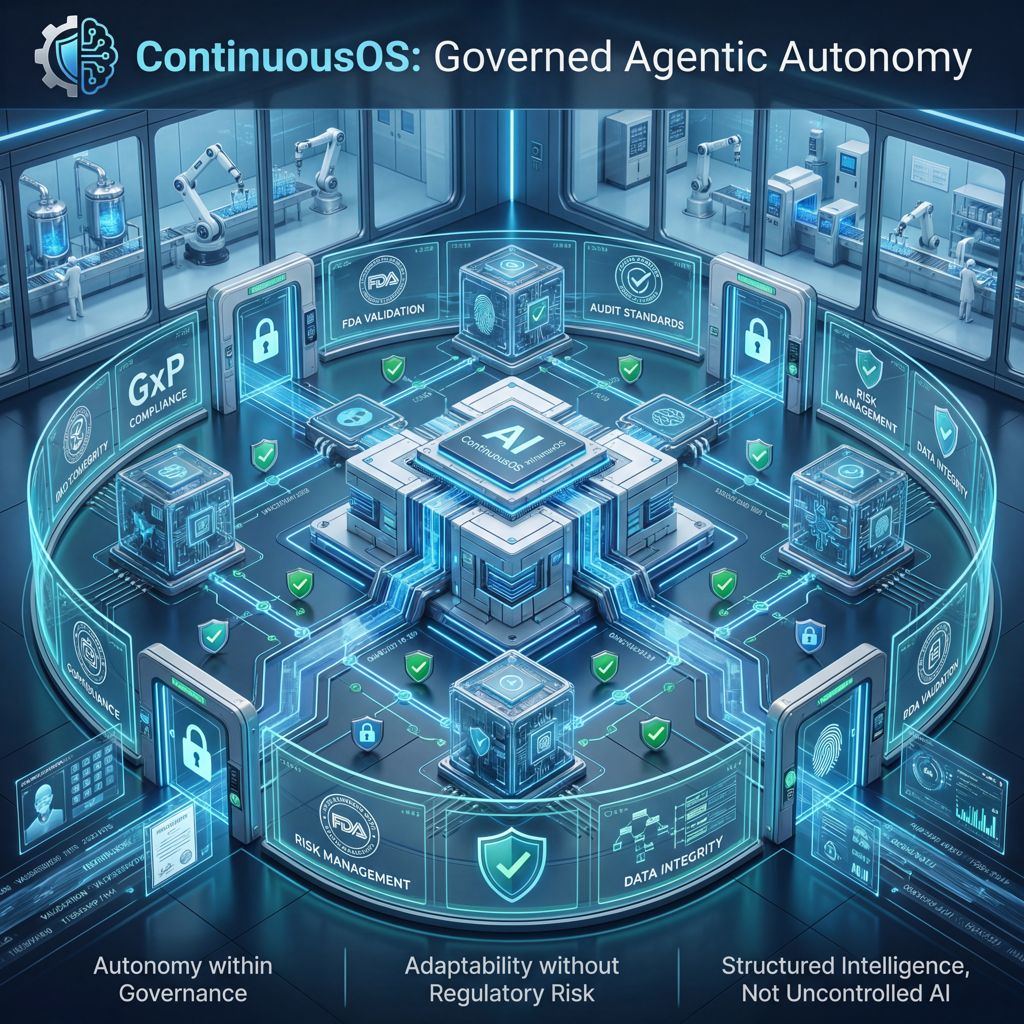
ContinuousOS by xLM treats agents as validated compliance primitives (@xLM Continuous Intelligence, AI in GxP Manufacturing, Revolutionizing GxP Manufacturing with ContinuousOS).
- Agents operate within predefined regulatory logic (GxP, validation, audit standards).
- Every decision pathway is traceable.
- HITL checkpoints embed at critical compliance boundaries.
ContinuousOS formalizes autonomy within governed constraints, ensuring adaptability without regulatory risk.
3.0. The Agentic Loop: Think → Act → Observe — Safely Closed
The “Think → Act → Observe” (@Google AI for Developers, Google Gemini 3 Flash Automates Visual Tasks with Think-Act-Observation Loop | Google AI for Developers posted on the topic | LinkedIn) cycle underpins agentic systems. Agents theoretically improve via feedback loops.
In practice, closing that loop presents challenges:
- Real-world feedback is sensitive and regulated, limiting use.
- Regulated settings forbid uncontrolled or unsupervised learning for compliance and safety.
- Autonomous retraining can invalidate prior validations, complicating model reliability.
- Safety limits prevent open-ended adaptation, ensuring controlled behavior.
Consequently, many “autonomous” systems rely on:
- Simulated environments - Virtual settings mimic real conditions, enabling safe, controlled testing without live risks.
- Narrow test loops - Focused iterative tests on small system parts quickly identify issues and refine features.
- Static evaluation datasets - Fixed data collections consistently measure system performance and compare tests.
True closed-loop learning in production remains rare.
3.1. How ContinuousOS + Human-in-the-Loop (HITL) solves this
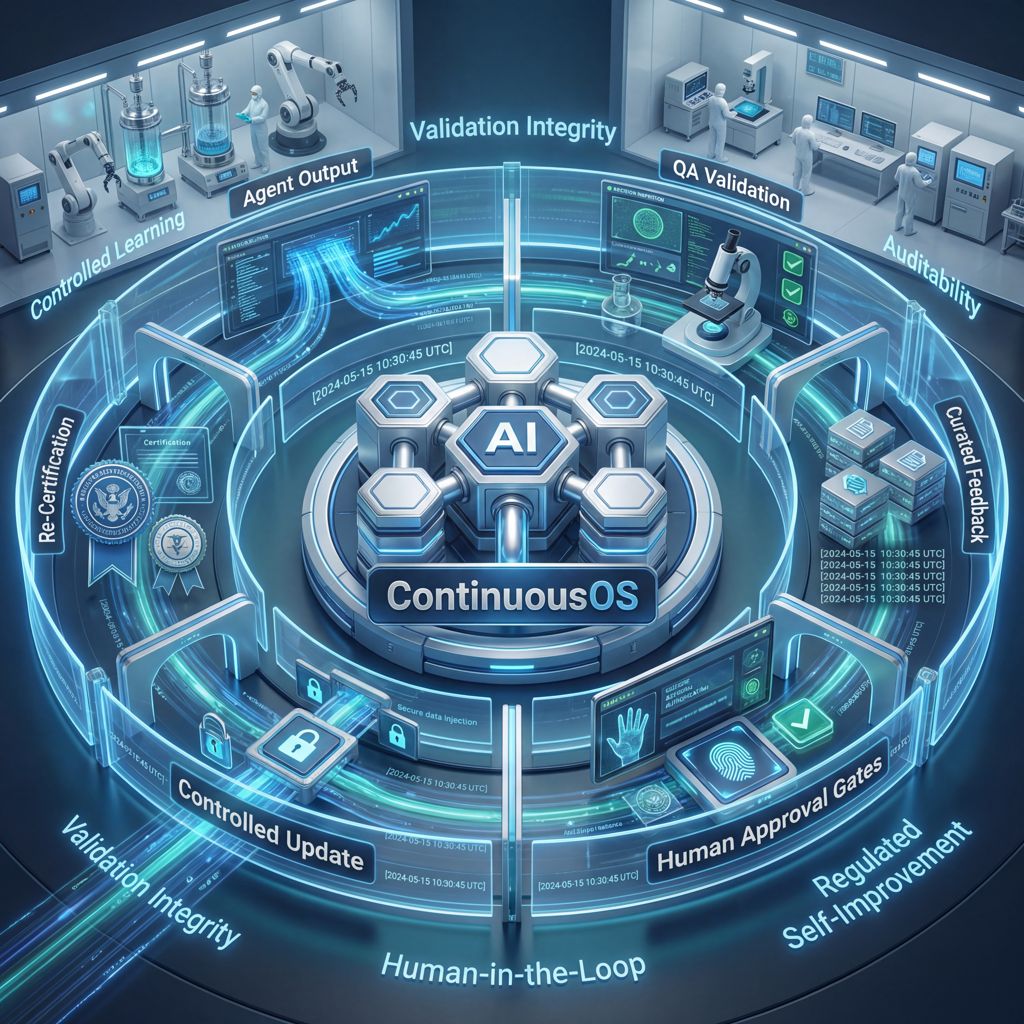
ContinuousOS (@xLM Continuous Intelligence, AI in GxP Manufacturing, Revolutionizing GxP Manufacturing with ContinuousOS) introduces controlled learning loops:
- Agent outputs undergo quality assurance validation to ensure accuracy and reliability.
- All feedback is curated, maintained under strict version control, and tracked through audit logs.
- Human approval gates determine permissible learning updates, ensuring oversight and control.
- Validation states are preserved and must be re-certified after any changes, maintaining system integrity.
ContinuousOS enables regulated self-improvement essential for GxP environments.
4.0. Governance & AgentOps: Beyond MLOps
Google introduces AgentOps as an extension of DevOps and MLOps for agent lifecycle management, a necessary progression (@ Benjamin D., AgentOps Is the New DevOps — Agents Now Have Authority).
However, governance for agents, especially in regulated industries, is more complex than ML model governance.
Regulated deployments require:
- Continuous validation documentation to verify compliance and performance.
- Immutable audit trails providing tamper-proof records for accountability.
- Explainable reasoning pathways offering clear decision justifications.
- Change control workflows ensuring review, approval, and documentation.
- Risk-based impact analysis prioritizing efforts by severity and likelihood.
- Evidence generation supplying verifiable data for audits and compliance.
Few tools meet ML governance standards, let alone agent governance standards.
4.1. How ContinuousOS + Human-in-the-Loop (HITL) solves this
ContinuousOS (@xLM Continuous Intelligence, AI in GxP Manufacturing, Revolutionizing GxP Manufacturing with ContinuousOS) embeds governance architecturally:
- Automated documentation generation cuts manual work and ensures accurate, consistent documents throughout the project.
- Built-in traceability matrices map requirements, design, implementation, and testing for easy tracking and full coverage.
- Continuous compliance monitoring detects and fixes deviations from regulations or policies to maintain adherence during development and deployment.
- Change control orchestration manages all modifications systematically, ensuring review, approval, and controlled, auditable implementation.
- Human sign-off before release adds verification and accountability by requiring authorized approval before going live
HITL is a compliance control mechanism, not an afterthought. This transforms AgentOps into ComplianceOps.
See How Pharma QA Teams Can Lead Agent Governance at Scale
5.0. Multi-Agent Collaboration & Self-Evolving Systems: The Risk of Compounding Errors
Google highlights multi-agent collaboration and self-evolving systems as the next frontier.
But collaboration without guardrails can cause:
- Cascading reasoning errors - An initial mistake triggers a chain of errors, leading to major wrong outcomes.
- Feedback amplification loops - Outputs fed back as inputs amplify effects, risking instability if unchecked.
- System drift - Gradual behavioral changes reduce performance or cause surprises.
- Compliance violations - Ignoring rules leads to legal issues, penalties, or reputation damage.
- Runaway agents - Autonomous agents acting beyond limits cause erratic or harmful behavior.
In regulated industries, compounded errors pose regulatory liabilities.
5.1. How ContinuousOS + HITL solves this
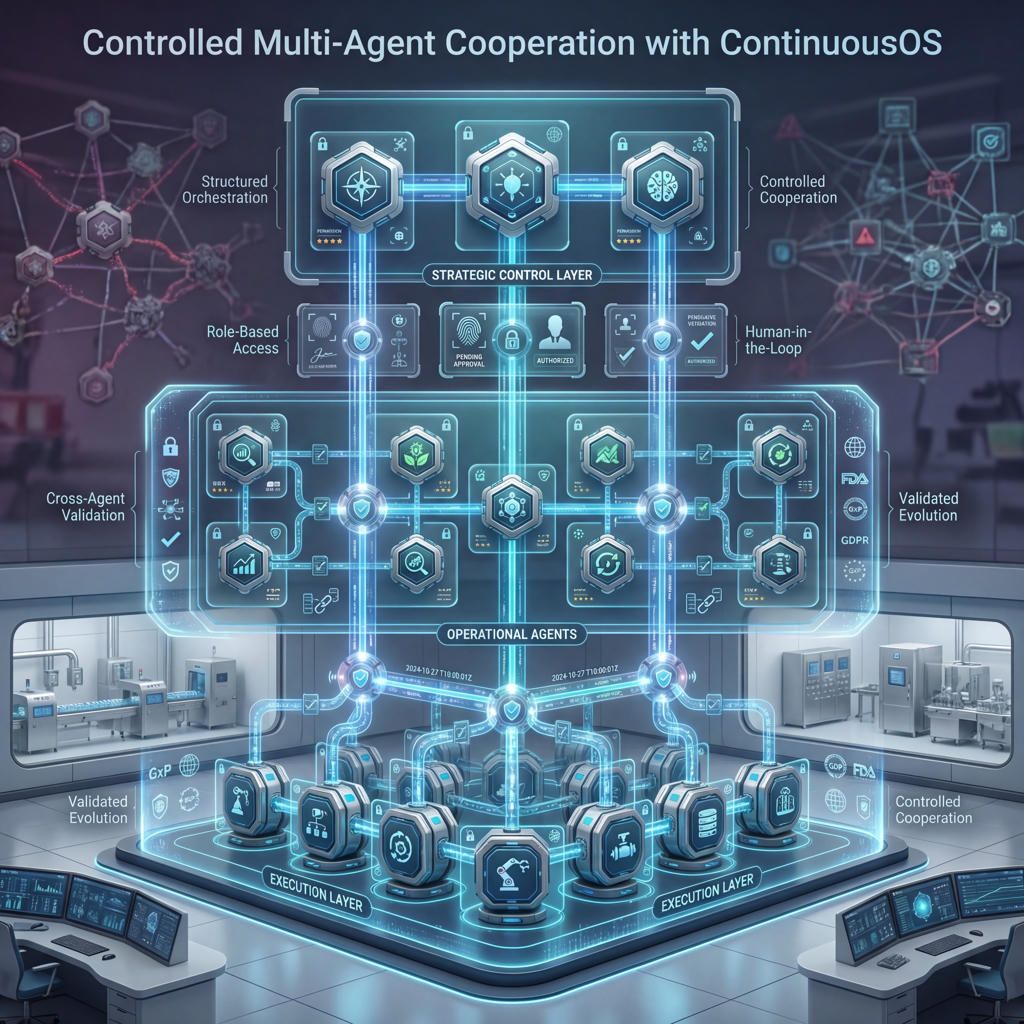
ContinuousOS mitigates risks through:
- Structured orchestration hierarchies define control levels and process flow within the system. They organize responsibilities and ensure smooth coordination among components.
- Role-based permissions restrict agents to functions and data suited to their roles. This boosts security by preventing unauthorized actions and data exposure.
- Cross-agent validation checkpoints verify actions and data integrity. These safeguards detect errors or inconsistencies early.
- Audit-logged inter-agent communication records all exchanges for accountability. This ensures transparency and allows retrospective review.
- Human approval gates oversee high-risk decisions to prevent mistakes (@xLM Continuous Intelligence, AI in GxP Manufacturing, ContinuousOS: Harnessing Generalist & Specialist AI Models for Always-On GxP Compliance). This intervention mitigates potential negative impacts.
Self-evolution occurs only within validated limits. Multi-agent collaboration becomes controlled cooperation, not emergent chaos.
6.0. Orchestration & Co-Intelligence: From HITL to Joint Accountability
Google identifies orchestration as the core of scalable agentic systems.
Transitioning from human-in-the-loop to co-intelligence requires:
- Defined trust frameworks - Clear rules for building and assessing trust.
- Clear accountability models - Roles and responsibilities assigned for accountability.
- Resilience engineering - Designing systems to anticipate and recover from failures.
- Fallback mechanisms - Backup procedures to maintain operations if primary methods fail.
- Shared decision authority models - Collaborative governance sharing decision power for transparency.
Current guidelines do not operationalize these requirements.
6.1. How ContinuousOS + HITL solves this
ContinuousOS operationalizes co-intelligence via:
- Explicit role separation between agents and human approvers.
- Tiered decision authority assigns power by role or seniority.
- Exception escalation workflows ensure proper resolution.
- Evidence-backed approvals rely on verified data.
- Transparent reasoning logs record decision rationale for accountability.
The result is not human replacement but human-AI joint accountability (@xLM Continuous Intelligence, AI in GxP Manufacturing, ContinuousOS: Harnessing Generalist & Specialist AI Models for Always-On GxP Compliance).
Enable Smarter Compliance for Pharma
7.0. The Bigger Question: Can Autonomy Exist Without Continuous Governance?
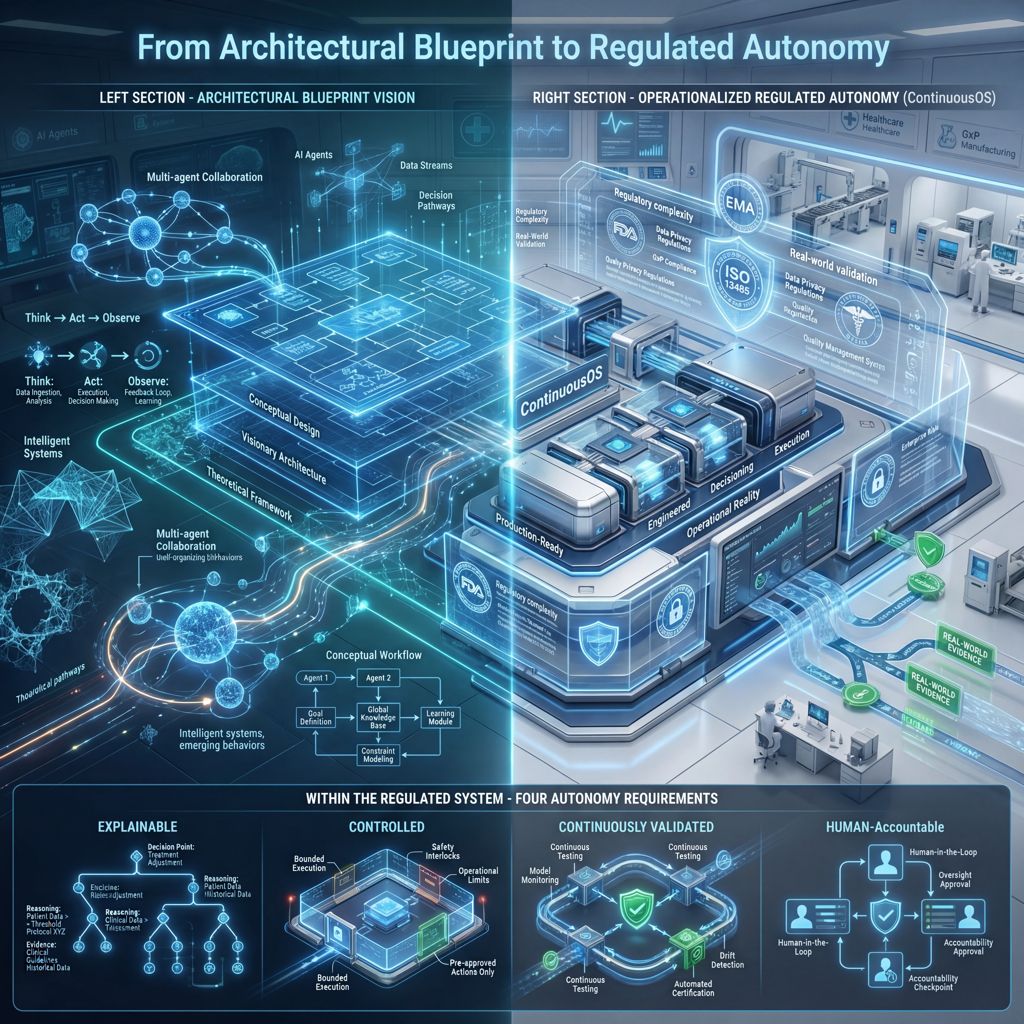
Google’s documentation provides an excellent architectural blueprint for agentic systems.
But architecture alone does not solve:
- Regulatory complexity - Navigating varied, evolving rules across regions and industries.
- Real-world validation - Validations in real scenarios ensure effective system performance beyond theory.
- Continuous auditability - Constant monitoring to ensure compliance and detect issues.
- Enterprise risk exposure - Protecting assets, reputation, and operations from threats.
In life sciences, autonomy must be:
- Explainable - Processes and decisions must be clearly understood by users and stakeholders.
- Controlled - Operations must remain within defined parameters for stability and predictability.
- Continuously validated - Ongoing testing ensures consistent performance and reliability.
- Human-accountable - Responsible individuals oversee actions and decisions to uphold ethics.
This is where ContinuousOS distinguishes itself.
7.1. How ContinuousOS + HITL solve these challenges
ContinuousOS, developed by xLM, embeds governance into its architecture transforming autonomy into regulated, inspection-ready intelligence.
ContinuousOS operationalizes governed autonomy via:
- Embedded & Version-Controlled Compliance Intelligence integrates regulatory logic into agent workflows with centralized version control, ensuring agents comply with standards like FDA, Annex 11, privacy laws, and QMS.
- Continuous Validation & Controlled Change Management logs all agent actions with auto-generated validation docs; structured review gates ensure updates are validated and approved before release.
- Immutable Auditability & Full Traceability audit trails and traceability link requirements, actions, outputs, and approvals to ensure constant inspection readiness.
- Controlled Orchestration & Risk Containment role-based permissions and orchestration hierarchies limit high-risk actions and prevent uncontrolled agent behavior.
- Human-in-the-Loop Governance & Explainability HITL checkpoints, exception escalations, and transparent logs keep decisions explainable, reviewable, and accountable.
The result is not autonomous opacity or human replacement but structured human-AI joint accountability (@xLM Continuous Intelligence, AI in GxP Manufacturing, ContinuousOS: Harnessing Generalist & Specialist AI Models for Always-On GxP Compliance).
ContinuousOS does not simply enable autonomy. It enables autonomy that is explainable, controlled, continuously validated, and human-accountable, ready for enterprise deployment in regulated environments.
8.0. Conclusion: The Case for ContinuousOS
As enterprises move from experimentation to production-grade autonomous systems, the conversation must shift:
From:
” How powerful are our agents? ”
To:
” How governable are they? ”
ContinuousOS demonstrates that:
- Autonomy and compliance can coexist, enabling independence within rules.
- Learning can be monitored and validated for accuracy and compliance.
- Multi-agent systems can safely collaborate using proper protocols.
- HITL accelerates governance, speeding oversight rather than causing delays.
- AgentOps should evolve into ComplianceOps, focusing on regulatory adherence.
In regulated environments, the future is not fully autonomous AI but continuously governed autonomy.
ContinuousOS represents the operating system built for that reality.
Implement Governed Agentic AI with ContinuousOS
About the Author

About Nagesh Nama
Nagesh Nama is the Founder and CEO of xLM Continuous Intelligence and ValiMation, bringing nearly 30 years of experience in AI-driven GxP compliance, computer system validation, and regulatory technology for the life sciences industry. A recognized thought leader, he pioneered the industry's first Continuous Validation platform supporting compliant IaaS, PaaS, and SaaS environments under 21 CFR Part 11 and Annex 11. His work focuses on advancing intelligent validation, AI-powered compliance, predictive maintenance, temperature mapping, and GxP AI agents to help pharmaceutical, biotechnology, and medical device organizations accelerate digital transformation while maintaining continuous compliance. Nagesh is a member of the Forbes Technology Council and the Fast Company Executive Board, a contributor to Forbes and Fast Company, and has been featured by Microsoft for his work in AI agents.