AI in Pharma R&D: Moving from Hype to Real Impact
Explore how AI in pharma R&D is moving from hype to real impact through practical use cases, strong governance, and compliant, data-driven workflows.
1.0. Introduction: From Conversation to Real Insights
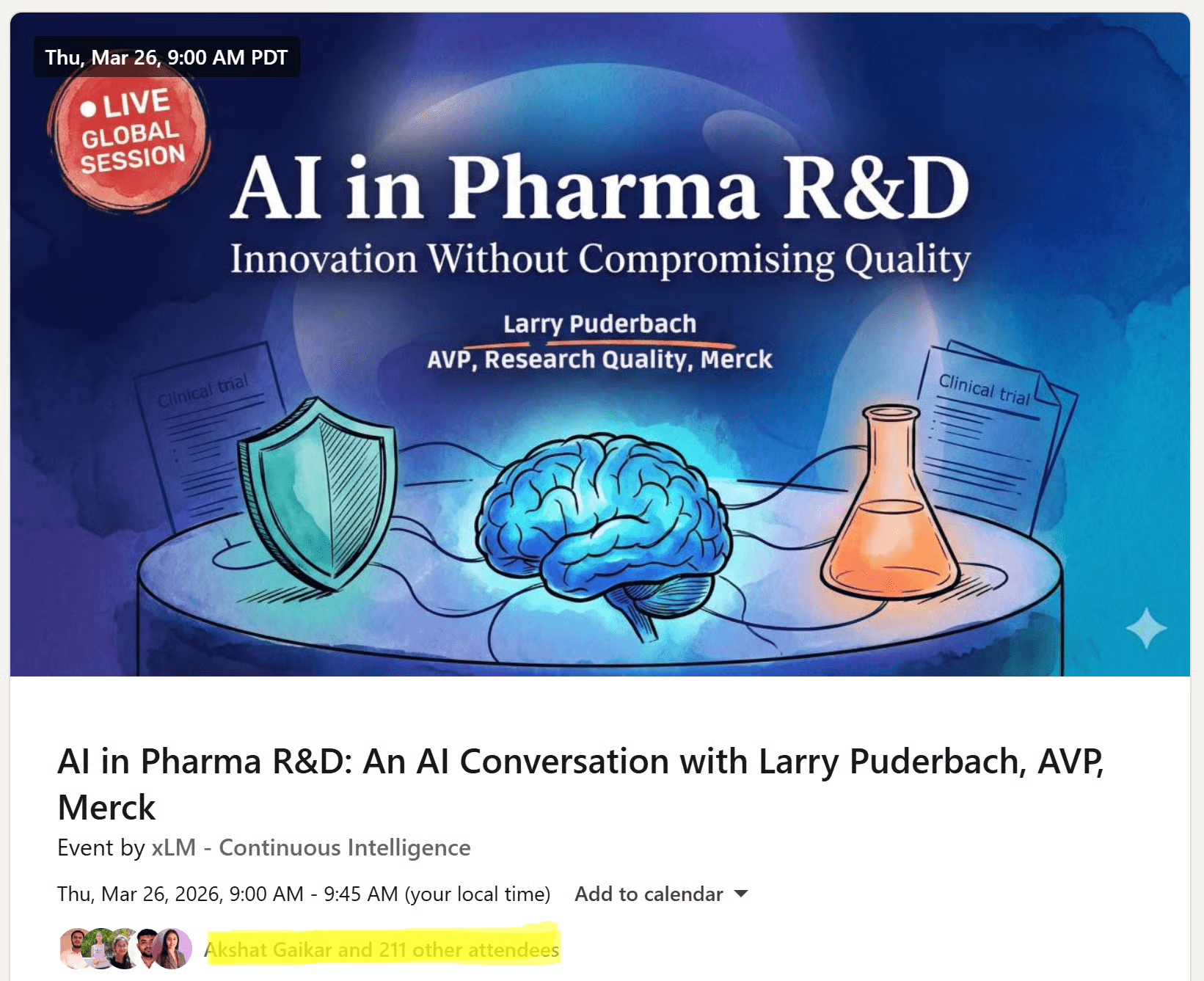
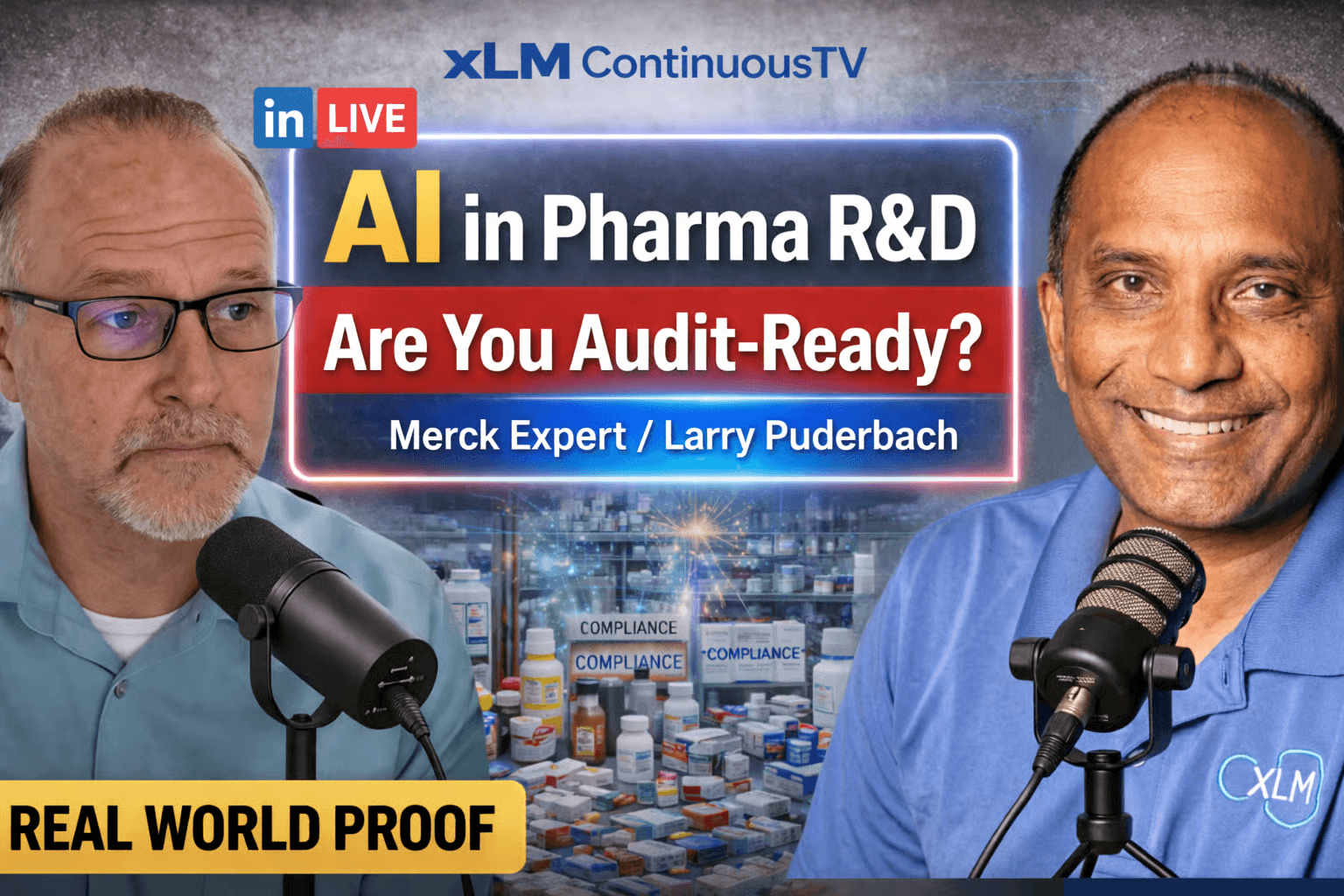
On March 26, 2026, xLM Continuous Intelligence hosted an engaging LinkedIn Live session on “AI in the Age of Regulated R&D: Governance, Risk, and Quality Leadership.”
The event's response showed the topic's urgency:
- 350+ registrations
- 100+ companies represented globally
- Participation from leaders across R&D, Quality, GxP, and Digital Transformation
This was not a typical webinar. With no slides and no scripted answers, the session offered real, unfiltered insights from the frontlines of pharmaceutical AI adoption.
As AI reshapes pharmaceutical R&D, from drug discovery to clinical trials, this discussion focused on a critical question:
What is actually working inside regulated pharma organizations today?
2.0. Speaker Spotlight
Larry Puderbach, Associate Vice President, Research Quality, Merck & Co.
With over 30 years of experience in GMP, compliance, and research quality, Larry leads global quality across:
- Preclinical and clinical research
- Pharmacovigilance quality
- Technology and analytics systems
- Enterprise quality governance
His unique perspective at the intersection of AI, quality, and regulatory compliance made this session insightful.
Explore Continuous Intelligent Validation for AI in GxP
3.0. Key Topics & Insights from the Session
The conversation revealed several powerful themes, many aligning with the event's short video highlights.
3.1. Overcoming Data Challenges for Real Impact
Pharma organizations have struggled with poor data quality, including unstructured formats and inconsistent entry, limiting analytics adoption. Early efforts also faced data access barriers, with siloed ownership and lack of trust across teams. Introducing clean data practices and modern systems improved usability. Establishing a centralized data governance committee and data lake streamlined access, enabling controlled, use-case-driven data use while maintaining oversight and compliance.
3.2. Real-World Use Cases Driving Impact
AI delivers value through live use cases like audit preparation and regulatory reference identification, reducing time and effort. AI-assisted report writing is in pilot, with plans to expand as more data becomes available. Initial resistance stemmed from job replacement fears, but user confidence grew after seeing results. AI serves as a support tool to assist auditors, enhancing efficiency while keeping human oversight.
3.3. Small, High-Impact Workflow Innovations
AI applies across key quality workflows, including audit preparation, regulatory citation mapping, and report drafting. These focused, high-impact use cases address specific process gaps. Such initiatives develop within business teams, not just centralized IT, enabling faster execution and better alignment with operational needs.
3.4. Why GxP AI Adoption Is Slower
AI adoption slows in GxP-regulated environments due to risk sensitivity and compliance needs. Organizations proceed cautiously compared to non-GxP settings. Validation, traceability, and regulatory acceptance add barriers, making progress measured and deliberate.
3.5. Growing Regulatory Alignment and Market Momentum
Global regulators like the FDA and EMA align on AI in drug development through new guiding principles. The EU AI Act introduces high-risk provisions affecting clinical trials and safety monitoring. These signals increasing regulatory clarity and oversight. Meanwhile, the AI clinical trials market is rapidly growing, projected to reach nearly $1.5 billion, showing strong industry momentum.
3.6. Industry Collaboration Driving Standards and Innovation
Industry consortiums like IMPALA unite 20+ pharma organizations to share analytics and AI use cases in research quality. These collaborations help companies learn and co-develop solutions for challenges like AI validation in GxP environments. They create shared principles, policies, and white papers to guide implementation. Aligning across industry reduces risk and ensures consistency with evolving regulations.
3.7. The Biggest Misconception About AI in Pharma
The industry both overestimates and underestimates AI. Early expectations focused on large, immediate transformation, which hasn’t fully materialized. Meanwhile, smaller, high-impact use cases were overlooked. AI delivers value through targeted, workflow-level improvements rather than big-bang change.
4.0. Final Thoughts: From Hype to Practical Execution
This session made one thing clear:
AI in pharma is no longer a future concept, it is an operational reality.
However, success is not defined by:
- Large-scale transformation that drives organization-wide improvements across processes, technology, and culture.
- Experimental pilots that test new ideas in controlled environments before scaling.
It is defined by:
- Practical use cases that apply specific tools to solve real problems and improve processes.
- Strong governance that ensures compliance, accountability, and effective oversight through robust policies.
- High-quality data that enables accurate insights and better decision-making through consistency and reliability.
- Human-centered implementation that focuses on user needs to create intuitive and effective solutions.
As pharmaceutical AI integration grows, winning organizations will:
- Balance innovation with compliance
- Build trust with regulators
- Embed AI into everyday workflows
AI will not replace GxP foundations. But it will reshape how those foundations execute, faster, smarter, and more efficiently.
5.0. About Our Guest
Associate Vice President, Merck Research Quality
Larry is a seasoned executive leader with over 30 years of experience in quality and risk management across GxPs. In his current role at Merck, he leads Research Quality supporting both preclinical and clinical studies, with responsibility spanning vendor, technology, process, laboratory/diagnostics, pharmacovigilance, and quality systems and analytics. His work is grounded in Quality by Design (QbD) principles, risk-based audit programs, and building transformative, data-driven quality programs. Larry also leads Merck's Division Risk Management Program and represents the division on the Enterprise Risk Management Committee. Prior to Merck, he held senior compliance and quality leadership roles at Pfizer (14+ years) and IBM, and served as an Adjunct Professor in Temple University's School of Pharmacy QA/RA Masters Program. Larry holds an MBA from Penn State University and completed executive programs at MIT and Harvard Business School.
6.0. About Our Host
CEO, xLM Continuous Intelligence | Founder, ValiMation
Nagesh is a pioneer in AI/ML-driven GxP compliance with nearly three decades of experience helping pharmaceutical, biotech, and medical device companies navigate validation, data integrity, and regulatory compliance. He is the founder and CEO of both ValiMation (founded 1996) and xLM Continuous Intelligence, the company that first introduced a Continuous Validation platform supporting IaaS/PaaS/SaaS environments compliant with 21 CFR Part 11 and Annex 11. Today, xLM offers a comprehensive suite of continuously validated AI/ML managed services spanning intelligent validation (cIV), predictive maintenance, temperature mapping, and GxP AI agents. Nagesh is a member of the Forbes Technology Council and the Fast Company Executive Board, a contributor to Forbes and Fast Company, and has been featured on Microsoft's AI Agents Vlog. He holds an M.S. in Manufacturing Engineering from the University of Massachusetts, Amherst.
About the Author

About Nagesh Nama
Nagesh Nama is the Founder and CEO of xLM Continuous Intelligence and ValiMation, bringing nearly 30 years of experience in AI-driven GxP compliance, computer system validation, and regulatory technology for the life sciences industry. A recognized thought leader, he pioneered the industry's first Continuous Validation platform supporting compliant IaaS, PaaS, and SaaS environments under 21 CFR Part 11 and Annex 11. His work focuses on advancing intelligent validation, AI-powered compliance, predictive maintenance, temperature mapping, and GxP AI agents to help pharmaceutical, biotechnology, and medical device organizations accelerate digital transformation while maintaining continuous compliance. Nagesh is a member of the Forbes Technology Council and the Fast Company Executive Board, a contributor to Forbes and Fast Company, and has been featured by Microsoft for his work in AI agents.