AI in Pharma Manufacturing: Compliance & Innovation
Discover how AI in pharma manufacturing enables real-time compliance, FDA ETP collaboration, and data-driven operations for smarter, compliant production.
1.0. Introduction: Why This Conversation Matters
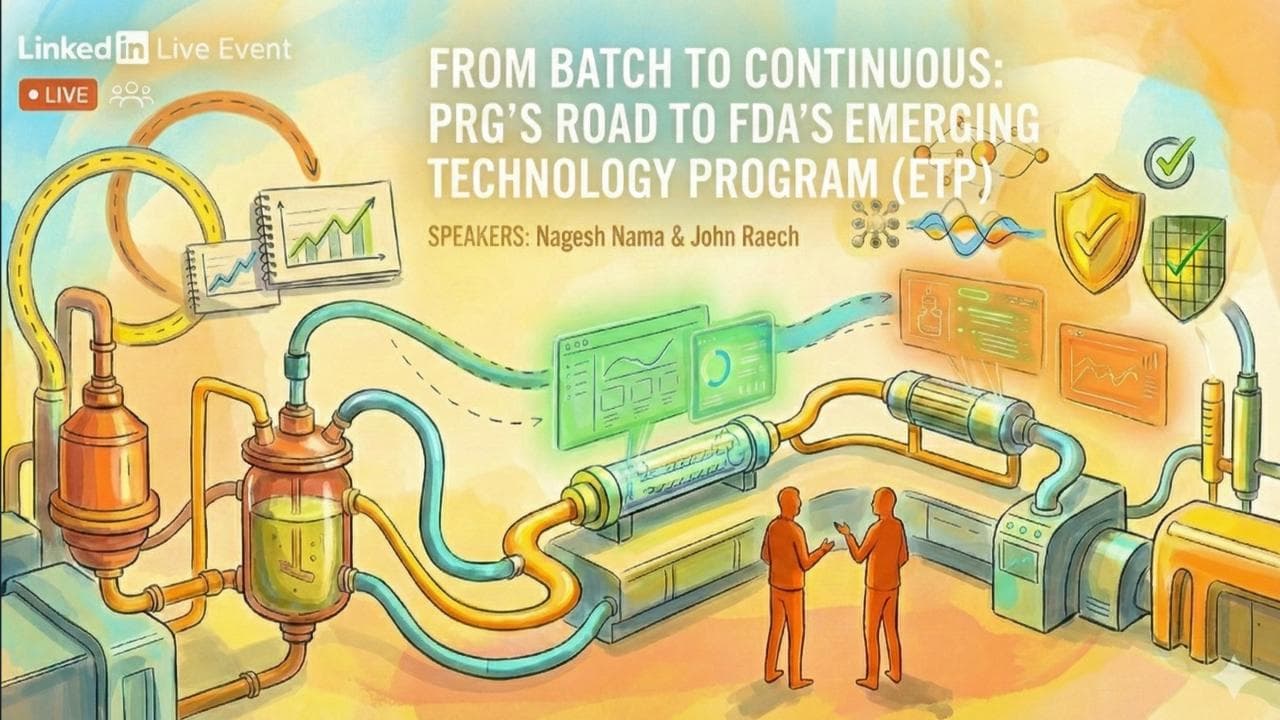
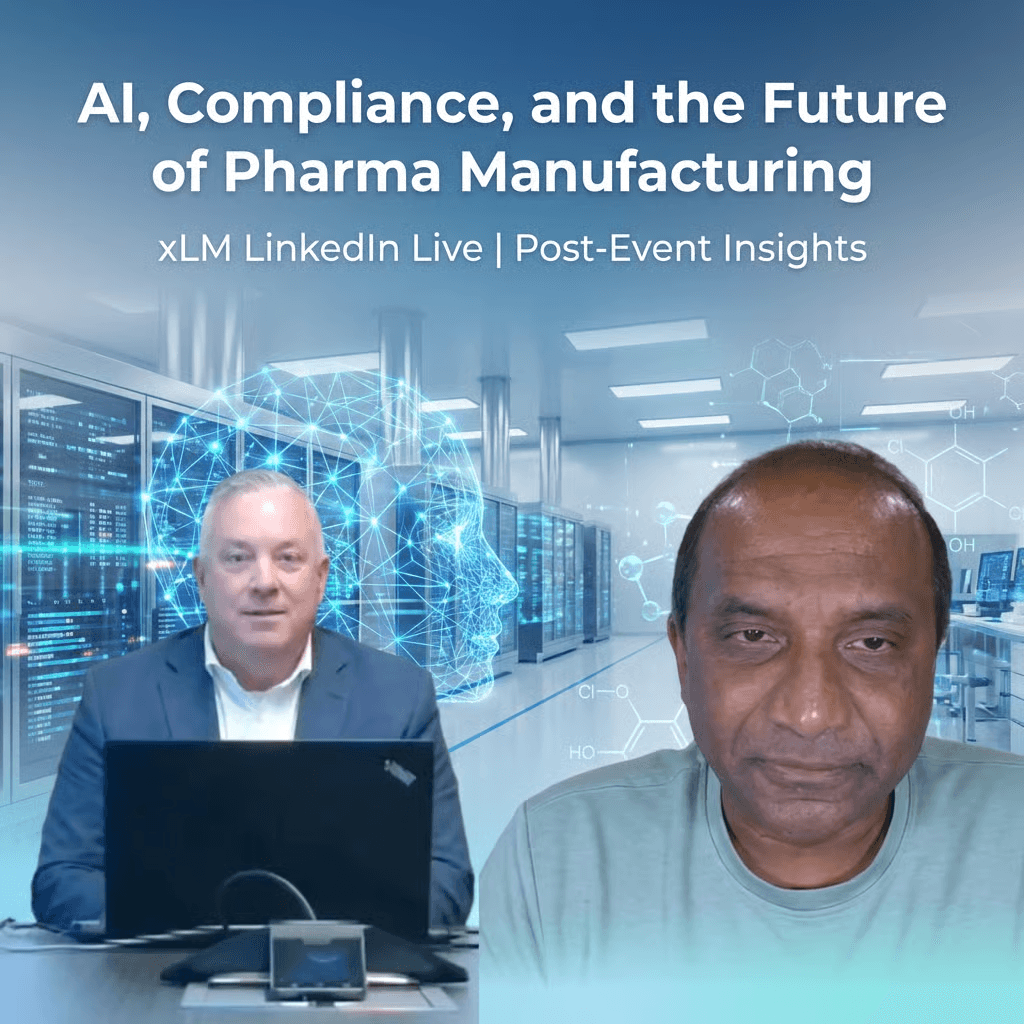
On April 23, 2026, xLM Continuous Intelligence hosted an engaging LinkedIn Live session with John Raech, CEO & Co-Founder of Pharma Resource Group (PRG) on “PRG's Road to FDA's Emerging Technology Program (ETP)”
The event's response showed the topic's urgency:
- 175+ registrations
- 50+ companies represented globally
- Participation from leaders across pharmaceutical operations, regulatory affairs, quality, and digital innovation.
The response showed the topic's growing urgency:
- Strong global participation from pharma, quality, and digital leaders
- Deep engagement across manufacturing, regulatory, and innovation domains
- Active discussion on AI, compliance, and next-generation API manufacturing
This was not a scripted webinar. It was a candid, experience-driven conversation about rethinking pharmaceutical manufacturing amid supply chain vulnerabilities, regulatory demands, and rapid technological change.
At the core was a critical question:
How do we build faster, smarter, and compliant pharmaceutical systems without compromising quality or regulatory trust?
Watch xLM ContinuousTV: Explore AI in Pharma Manufacturing
2.0. Key Insights: How Pharma is Evolving
The conversation journeyed from industry realities to bold innovation, highlighting how pharma must evolve in technology, regulation, and mindset.
2.1. AI in Pharma: From Reactive to Real-Time Compliance
A major theme was transforming compliance through AI. Currently, compliance is retrospective, requiring manual proof that processes were followed. Even with SOPs, organizations often lack real-time visibility into execution. Preparing inspection documentation can take weeks, making compliance reactive and resource-intensive.
AI leverages digital data streams and contextual intelligence to provide continuous visibility. Organizations can see in real time if processes comply and where deviations occur. This context-driven intelligence shifts compliance from static documentation to dynamic, always-on systems, making it proactive rather than periodic.
2.2. API Manufacturing: Challenges and the Need for Innovation
The session offered a grounded view of U.S. API manufacturing. Despite reshoring efforts, domestic API production remains a small share of global supply. Many critical APIs and raw materials are still sourced internationally, reflecting deep structural dependencies.
Rebuilding this capacity is complex. Traditional batch facilities require high capital investment, long timelines, and large-scale infrastructure, limiting rapid expansion. The industry must innovate rather than replicate, developing flexible, efficient, and scalable systems to address current gaps and emerging needs.
2.3. FDA Emerging Technology Program (ETP): A New Regulatory Model
Another key insight was the value of early, proactive regulatory engagement through the FDA’s Emerging Technology Program (ETP). Traditionally, validation occurs during submissions or inspections, often causing late-stage delays and rework.
ETP enables organizations to collaborate with the FDA early in development, validating strategies, technologies, and processes before major investments. This ensures alignment upfront, avoiding costly missteps later.
This model reduces uncertainty and builds confidence in innovation. It reflects a broader shift toward regulatory engagement and transparency as enablers of progress, not barriers.
2.4. Regulatory Speed: Why Pharma Moves “One Molecule at a Time”
The discussion on speed reinforced a critical reality that progress in pharma is governed by regulatory and quality standards.
Organizations can only move as fast as approvals allow. This leads to a deliberate strategy of progressing one molecule at a time and expanding capabilities incrementally. Instead of building large capacity upfront, the focus is on step-by-step validation and compliance.
Speed in pharma is not about moving fast blindly; it is about moving responsibly within a regulated framework. Quality and compliance define sustainable progress, not constraints.
2.5. Data-Driven Equipment Maintenance: From Fixed Schedules to Intelligent Decisions
A practical example of AI’s impact is equipment maintenance. Today, maintenance follows fixed, time-based schedules, regardless of actual usage, causing inefficiencies and unnecessary interventions.
The future lies in data-driven maintenance models. By analyzing operational data, organizations can monitor equipment performance in real time and make decisions based on actual usage and condition. This enables a shift to predictive and condition-based maintenance, improving efficiency and reducing downtime.
However, implementing this in legacy environments is challenging, giving digital-first, greenfield facilities a strategic advantage.
2.6. Innovation Requires Vision, Risk, and Collaboration
Beyond technology and strategy, the session concluded with a personal reflection on innovation. Building a next-generation pharmaceutical facility requires significant commitment, risk-taking, and long-term vision.
This journey involved stepping away from stable corporate roles to pursue a vision without guaranteed outcomes. It demanded conviction, resilience, and willingness to embrace uncertainty, while reinforcing the importance of collaboration and surrounding yourself with the right people.
Ultimately, innovation in pharma is not driven by individuals alone. It results from collective effort, shared expertise, and commitment to building something meaningful beyond any single organization.
3.0. Final Thoughts: From Innovation to Execution
This session made one thing clear that the future of pharmaceutical manufacturing depends on integrating innovation and compliance.
Success will not come from simply scaling traditional models or adopting new technologies in isolation. It requires building systems where AI enables real-time visibility, regulatory collaboration starts early, and data drives operational decision-making.
As the industry evolves, successful organizations will move deliberately, design with compliance at the core, and embrace ecosystem collaboration. AI will not replace pharma’s foundations, but it will transform how those foundations are executed, making systems more transparent, intelligent, and resilient.
4.0. About our Guest
John Raech
CEO & Co-Founder of Pharma Resource Group (PRG)
John Raech is a pharmaceutical manufacturing leader with 30+ years in API manufacturing, quality, and global operations. As CEO and Co-Founder of Pharma Resource Group (PRG), he leads a next-gen U.S. API facility using advanced tech, modular design, and data-driven operations. He reimagines pharmaceutical manufacturing by focusing on innovation, regulatory alignment, efficiency, and digital-first infrastructure. He drives initiatives with modern processes, AI systems, and flexible models to boost supply chain resilience and domestic production. Before PRG, John held senior roles managing large-scale pharma operations, process improvements, and strategic initiatives globally, covering plant operations, engineering, compliance, and transformation. His leadership stresses practical execution, regulatory collaboration, and strong teams. He is dedicated to advancing pharma manufacturing through innovation, partnerships, and a long-term vision for resilient U.S.-based API production.
5.0. About our Host
Nagesh Nama
CEO, xLM Continuous Intelligence | Founder, ValiMation
Nagesh is a pioneer in AI/ML-driven GxP compliance with nearly three decades of experience helping pharmaceutical, biotech, and medical device companies navigate validation, data integrity, and regulatory compliance. He is the founder and CEO of both ValiMation (founded 1996) and xLM Continuous Intelligence, the company that first introduced a Continuous Validation platform supporting IaaS/PaaS/SaaS environments compliant with 21 CFR Part 11 and Annex 11. Today, xLM offers a comprehensive suite of continuously validated AI/ML managed services spanning intelligent validation (cIV), predictive maintenance, temperature mapping, and GxP AI agents. Nagesh is a member of the Forbes Technology Council and the Fast Company Executive Board, a contributor to Forbes and Fast Company, and has been featured on Microsoft's AI Agents Vlog. He holds an M.S. in Manufacturing Engineering from the University of Massachusetts, Amherst.
Connect with Nagesh on LinkedIn
Book a Demo to Experience AI-Driven, Real-Time Compliance with xLM
About the Author

About Nagesh Nama
Nagesh Nama is the Founder and CEO of xLM Continuous Intelligence and ValiMation, bringing nearly 30 years of experience in AI-driven GxP compliance, computer system validation, and regulatory technology for the life sciences industry. A recognized thought leader, he pioneered the industry's first Continuous Validation platform supporting compliant IaaS, PaaS, and SaaS environments under 21 CFR Part 11 and Annex 11. His work focuses on advancing intelligent validation, AI-powered compliance, predictive maintenance, temperature mapping, and GxP AI agents to help pharmaceutical, biotechnology, and medical device organizations accelerate digital transformation while maintaining continuous compliance. Nagesh is a member of the Forbes Technology Council and the Fast Company Executive Board, a contributor to Forbes and Fast Company, and has been featured by Microsoft for his work in AI agents.