Continuous Intelligent Validation: Faster GxP Execution
Continuous Intelligent Validation (cIV) uses agentic AI to accelerate GxP execution, replacing manual validation with continuous, compliant, scalable automation.
1.0. Introduction: Why Traditional GxP Validation No Longer Works
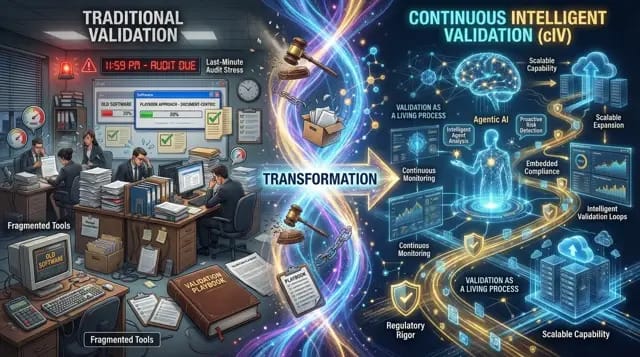
For decades, software validation in regulated environments has followed the same playbook: manual documentation, fragmented tools, human-heavy execution, and last-minute audit stress. Despite advances in software delivery, validation remains largely unchanged.
Continuous Intelligent Validation (cIV) was built to break this cycle.
Powered by agentic AI and grounded in regulatory rigor, cIV transforms validation from a slow, document-centric obligation into a continuous, intelligent, and scalable capability.
Join us for an unscripted LinkedIn Live podcast hosted by xLM Continuous Intelligence in conversation with Mr. Bob Buhlmann, a seasoned pharma leader with experience from consulting to senior roles at Amgen, now Head of Quality, Digital and Computer Strategy at AstraZeneca.This live discussion explores how AI is applied in GxP-regulated manufacturing environments, drawing on global operations experience. Mr. Buhlmann offers a regulatory perspective, having engaged with global health authorities including the FDA (USA), EMA (EuroZone), MHRA (UK), MPA (Sweden), NMPA (China), while overseeing AI adoption across IT and manufacturing.
Watch the LinkedIn Live: GxP in the Age of AI
2.0. The Legacy Validation Model: Where Time, Cost, and Risk Accumulate
Most GxP organizations still rely on legacy validation approaches that were never designed for today’s pace of change.
In legacy validation models, execution is manual, sequential, and highly variable.
Once requirements are defined:
- SMEs manually author URS documents, often in isolation
- Different teams create test plans later
- Traceability matrices are assembled near the end under schedule pressure
- Each artifact is produced sequentially, requiring rework when requirements change
During test execution:
- Test scripts are written manually
- Individual testers execute tests manually
- Evidence is captured manually via screenshots, notes, and timestamps
- Assertions rely on human judgment, not system verification
As validation progresses:
- Traceability is maintained and updated manually in spreadsheets
- URS, test plans, and execution evidence drift out of sync
- Missing links, incorrect mappings, and outdated references are common audit findings
Because validation occurs after development:
- Go-lives are delayed
- Approvals are rushed
A single validation cycle can take weeks or months, with high cost, inconsistent quality, and elevated compliance risk making validation a bottleneck rather than an enabler of digital transformation.

3.0. Continuous Intelligent Validation: A Fundamentally Different Approach
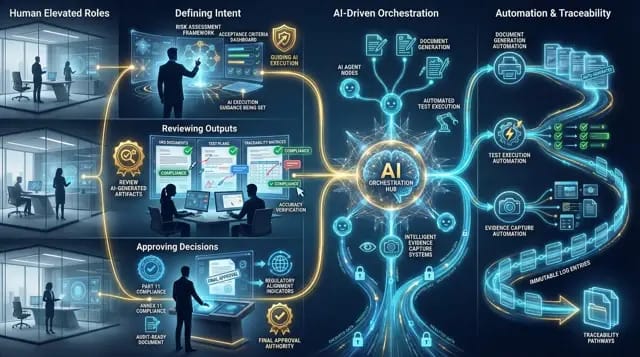
cIV replaces fragmented, manual validation workflows with AI-driven validation orchestration, preserving regulatory compliance and meaningful human oversight.
Human roles are elevated to:
- Defining intent: Humans define validation scope, risk, and acceptance criteria, guiding AI execution without manual document authoring.
- Reviewing outputs: SMEs and QA teams review AI-generated URS, test plans, traceability, and execution reports for accuracy and compliance.
- Approving decisions: Authorized reviewers provide final approval on controlled, audit-ready documents aligned with Part 11 and Annex 11.
Everything else is automated, logged, and traceable:
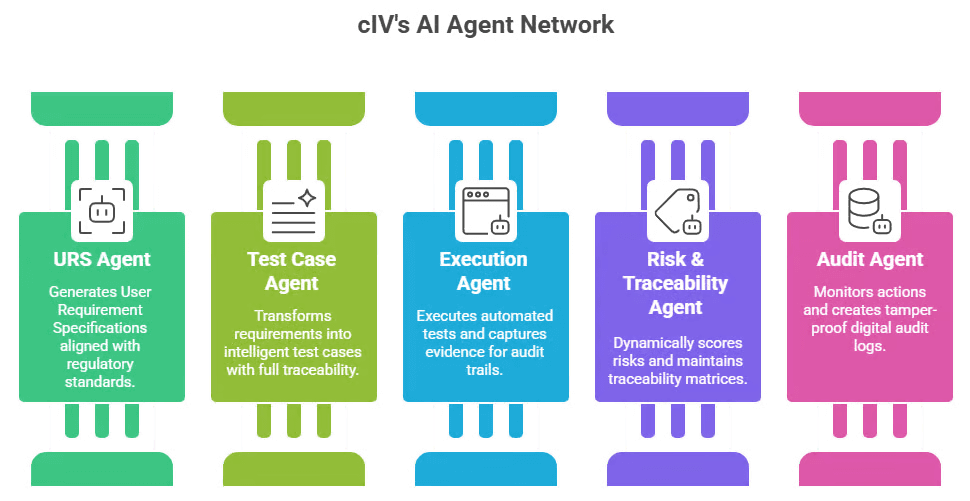
AI agents handle document generation, test execution, and evidence capture, while every action is immutably logged to ensure continuous traceability and audit readiness.
Learn More About Continuous Intelligent Validation (cIV)
4.0. Intelligent Automation Across the Validation Lifecycle
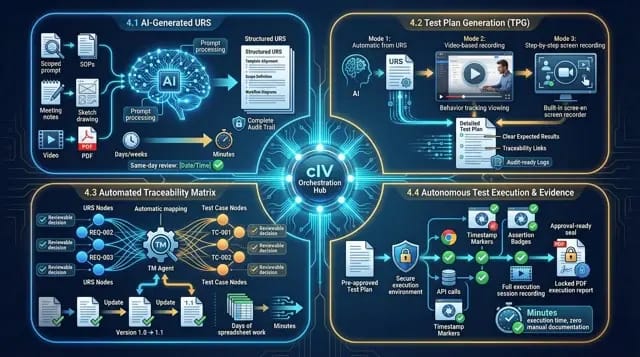
cIV provides end-to-end automation for the software validation lifecycle, replacing manual, disconnected tasks with coordinated, AI-driven agents. From requirements definition to test execution and evidence generation, each validation artifact is created intelligently, maintained continuously, and fully traceable, while preserving human review and regulatory control. This results in a validation process that is faster, more reliable, and audit-ready by design.
4.1. AI-Generated User Requirement Specifications (URS)
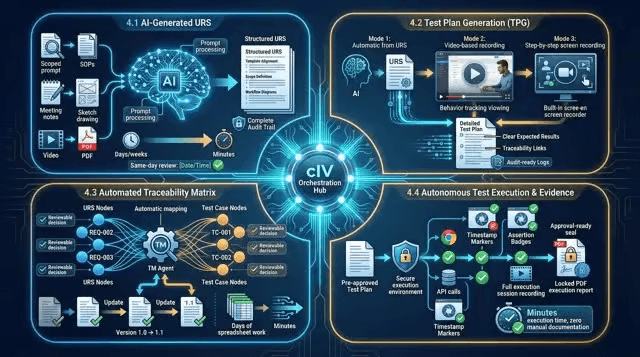
With cIV, URS authoring shifts from manual drafting to prompt-driven intelligence.
Users submit:
- A scoped prompt
- Supporting materials (meeting audio notes, sketches, videos, PDFs)
Within minutes, cIV produces:
- A structured, template-aligned URS
- Clearly defined scope and exclusions
- Workflow diagrams where appropriate
- A complete audit trail of AI reasoning
What traditionally takes days or weeks is delivered in minutes, ready for same-day review.
4.2. Test Plan Generation (TPG): From Observation to Documentation
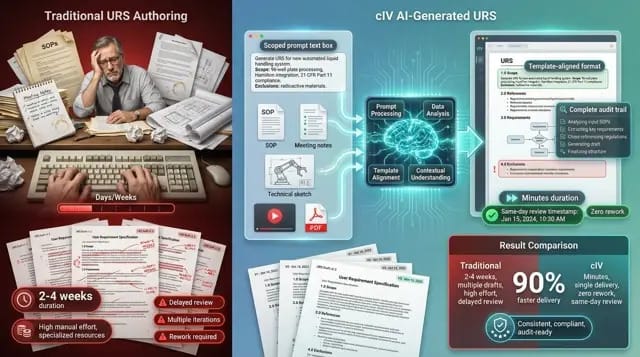
cIV supports three modes of test plan generation:
- Automatic generation from URS
- Video-based recording of test behavior
- Step-by-step screen recording using a built-in recorder
Regardless of method, cIV generates:
- Detailed, editable test plans
- Clear expected results
- Full traceability
- Audit-ready logs
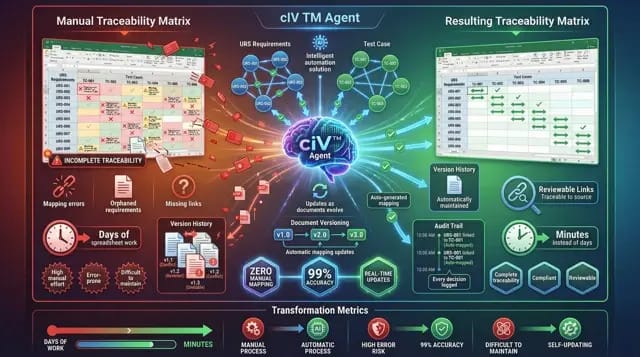
4.3. Automated Traceability Matrix (TM)
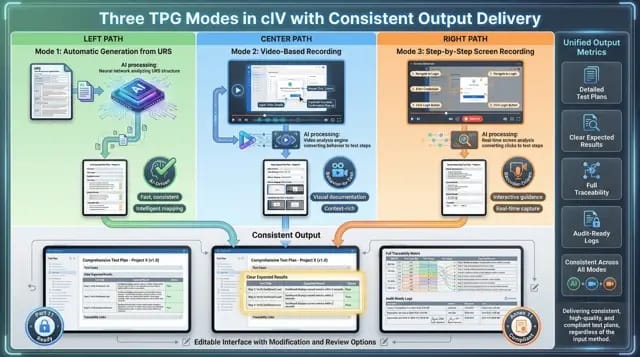
cIV eliminates one of validation’s most error-prone tasks.
The TM agent:
- Automatically maps URS to test cases
- Supports two-way traceability
- Updates mappings as documents evolve
What once took days of spreadsheet work now takes minutes, with every decision logged and reviewable.
4.4. Autonomous Test Execution & Evidence Capture
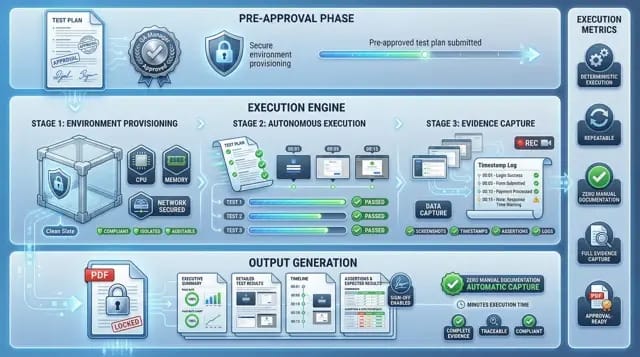
With cIV, execution becomes deterministic and repeatable.
Once a pre-approved test plan is submitted:
- cIV provisions a secure execution environment
- Executes tests autonomously
- Captures screenshots, timestamps, and assertions
- Records the full execution session
- Generates a locked, approval-ready PDF execution report
A full execution, including evidence capture, can complete in minutes, with zero manual documentation effort.
Watch the Full Continuous Intelligent Validation (cIV) Demo
5.0. The ROI of Continuous Intelligent Validation
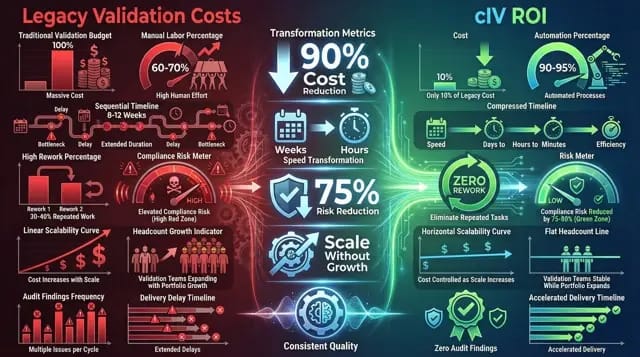
Legacy validation consumes significant time, budget, and human effort yet exposes organizations to audit risk and delivery delays. Continuous Intelligent Validation (cIV) changes validation economics by replacing manual, sequential processes with intelligent automation (which is compliant by design). The result is measurable return on investment across cost, speed, risk reduction, and scalability.
1. Up to 90% Reduction in Validation Costs
Traditional validation relies heavily on manual labor for document authoring, test design, execution, and evidence collection, each requiring specialized resources and repeated rework. cIV automates URS generation, test planning, execution, traceability, and reporting. Organizations typically spend a fraction of their historical validation budgets, improving consistency and quality simultaneously.
2. Dramatically Compressed Validation Timelines
Legacy validation activities stretch across weeks or months due to sequential dependencies and human availability. With cIV, validation artifacts generate in parallel and execution is fully automated, reducing cycle times from weeks to hours and days to minutes. This enables faster system releases, quicker change adoption, and smoother go-lives without last-minute bottlenecks.
3. Lower Compliance and Audit Risk
Manual validation introduces variability, incomplete evidence, and documentation gaps auditors routinely identify. cIV enforces consistency through deterministic execution, automated assertions, and end-to-end traceability. Every action is logged, every result captured, and every decision reviewable, shifting audits from subjective explanation to objective demonstration backed by verifiable evidence.
4. Scalable Validation Without Headcount Growth
As digital portfolios expand, traditional validation scales linearly with people and cost. cIV scales horizontally through automation, supporting multiple systems, platforms, and releases without increasing validation teams. This lets organizations grow their application landscape while controlling validation effort, cost, and complexity.
6.0. From Validation Gatekeeper to Digital Accelerator
Legacy validation models were designed for static systems, infrequent releases, and slow, linear change, making validation a control point organizations had to pass through rather than a capability that worked with development. In these environments, validation delays releases, increases friction, and constrains innovation.
cIV is built for continuous delivery, continuous compliance, and continuous assurance, embedding validation directly into modern digital systems' lifecycle. By automating validation activities and maintaining real-time traceability and evidence, cIV lets teams move faster without sacrificing regulatory rigor.
Validation no longer slows innovation. With cIV, validation becomes the mechanism that enables scale, speed, and trust in regulated digital transformation.
“Continuous Intelligent Validation isn’t an upgrade to legacy validation. It’s a complete replacement.”
About the Author

About Kashyap Joshi
Kashyap Joshi serves as Director of Partnerships and Program Management at xLM Continuous Intelligence, where he drives strategic partnerships and leads the successful delivery of AI and machine learning initiatives for life sciences organizations. With expertise in GxP compliance, continuous validation, and digital transformation, he helps pharmaceutical, biotechnology, and medical device companies adopt innovative technologies while maintaining regulatory compliance and operational excellence. Kashyap plays a key role in advancing xLM's AI-powered solutions and ContinuousOS Suite of Apps, enabling organizations to accelerate modernization, improve efficiency, and achieve measurable business outcomes through intelligent automation, continuous compliance, and scalable AI-driven transformation.