
FDA's PCCP Guidance for AI-Enabled Medical Devices
Learn how the FDA's PCCP guidance enables AI-enabled medical devices through continuous validation, risk management, lifecycle governance, and compliance.
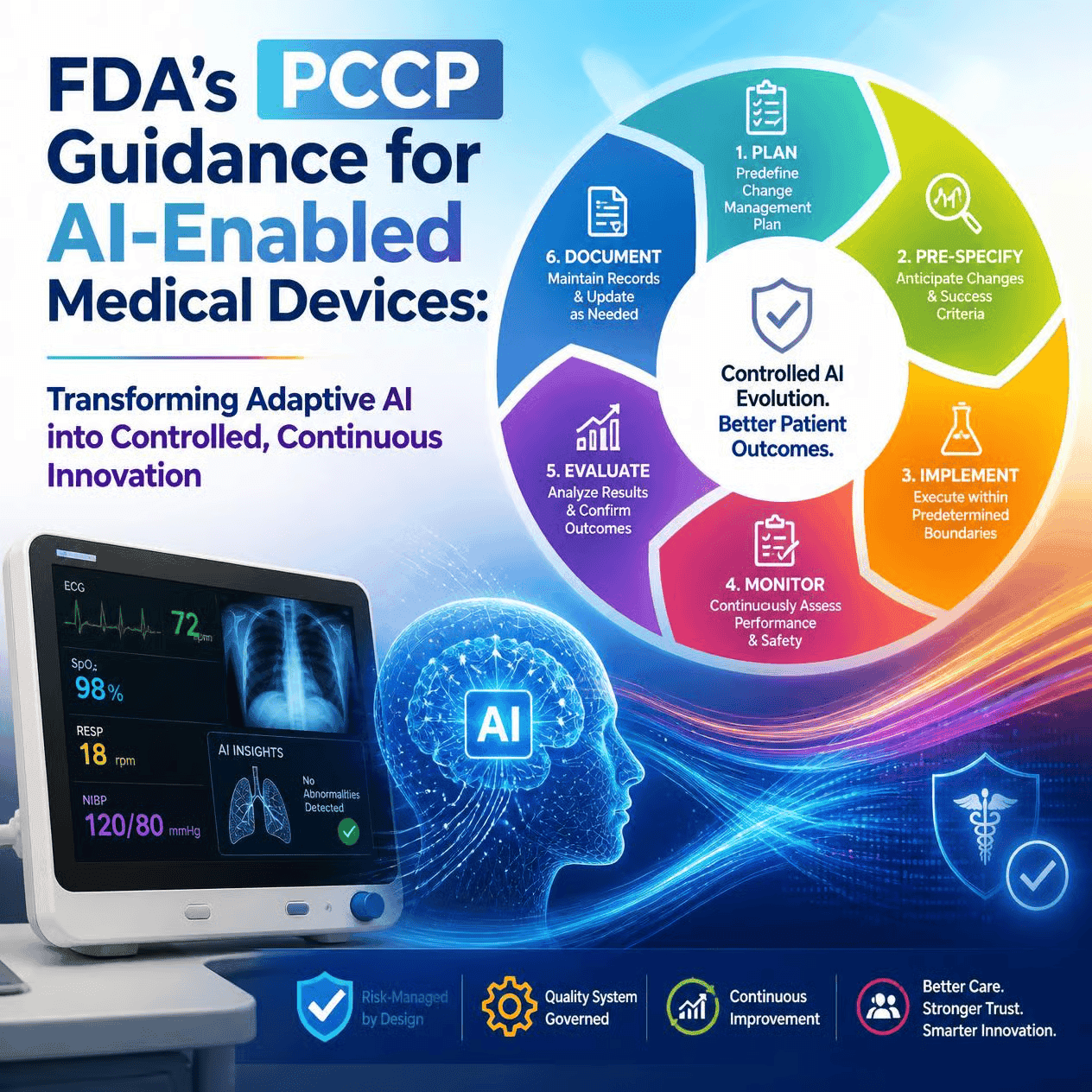
1.0. Introduction
The rapid adoption of Artificial Intelligence (AI) and Machine Learning (ML) in medical devices presents a key regulatory challenge: how can intelligent systems improve after approval while ensuring safety, effectiveness, and compliance?
The U.S. Food and Drug Administration's guidance, Marketing Submission Recommendations for a Predetermined Change Control Plan for Artificial Intelligence-Enabled Device Software Functions, introduces the Predetermined Change Control Plan (PCCP) framework. Instead of treating each model update as a separate regulatory event, the FDA offers a structured way to define, validate, control, and govern specific future modifications to AI-enabled devices.
This guidance establishes a new paradigm for AI lifecycle governance, shifting from episodic software approvals to continuous validation, controlled adaptation, and prospective regulatory oversight.
2.0. Why the PCCP Matters for AI-Enabled Medical Devices
Traditional medical devices are static products. Once approved, their functionality stays mostly unchanged until a formal modification is submitted. However, AI-enabled Device Software Functions (AI-DSFs) improve through retraining, optimization, new data, environmental adaptation, and algorithm refinement.
Without a structured regulatory mechanism, every significant algorithm update would require a new FDA submission, creating operational burdens and limiting continuous improvement. The PCCP framework lets manufacturers prospectively define future modifications during the original authorization.
Under PCCP, manufacturers specify what changes may occur, how they will be implemented and validated, and how risks will be controlled. Once FDA authorizes these, modifications within the approved PCCP can proceed without new submissions.
The FDA emphasizes that PCCP is not a shortcut but a shift from reactive regulatory review to proactive lifecycle management, with evidence generation, risk assessment, and validation designed and controlled in advance.
3.0. The Three Foundational Elements of a PCCP
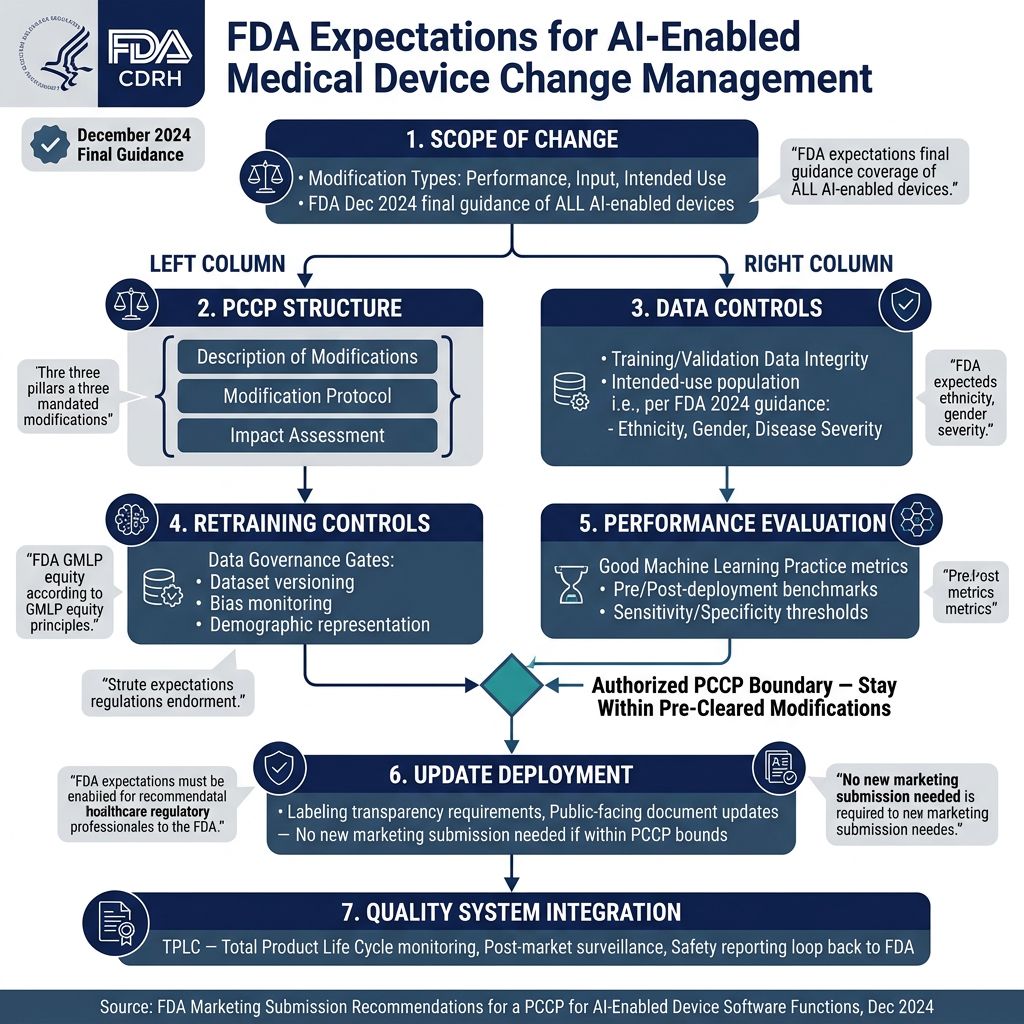
The FDA defines PCCP as three core components: the Description of Modifications, the Modification Protocol, and the Impact Assessment.
The Description of Modifications specifies changes during the device lifecycle, such as model retraining with new data, threshold optimization, compatibility expansion, subpopulation refinement, or infrastructure updates. The FDA expects specific definitions, avoiding vague future improvement statements.
The Modification Protocol sets procedures for future changes, detailing data collection, management, validation, retraining, performance evaluation, deployment, and monitoring.
The Impact Assessment evaluates benefits, risks, interactions, and cumulative effects to ensure safety and effectiveness while supporting improvement. Together, these elements make AI change management a controlled, auditable regulatory process.
4.0. Key Regulatory Implications for MedTech Manufacturers
The FDA guidance stresses that AI change management cannot be an afterthought; manufacturers must integrate lifecycle management from product design through post-market surveillance.
Manufacturers must define the precise scope of future modifications, including purpose, technical boundaries, validation, and performance limits. Broad statements like "the model may improve over time" are insufficient. Organizations must specify what changes may occur, under which conditions, and within predefined constraints.
The FDA elevates data governance from an engineering concern to a regulatory requirement. Manufacturers must demonstrate how datasets are collected, annotated, curated, stored, retained, and controlled throughout the AI lifecycle.
Retraining activities become regulated processes, requiring predefined triggers, controlled methods, safeguards against overfitting and bias, acceptance criteria, and documented approvals.
Performance evaluation demands more rigor. Manufacturers must show that updated models maintain safety and effectiveness across intended populations and clinical settings, not just improved internal benchmarks.
Deployment strategies are safety controls. Whether updates are manual, automatic, global, or local, manufacturers must define user notifications, version management, and deployment risk controls.
The FDA links PCCP execution to the organization's Quality Management System (QMS), requiring integration with design controls, change management, CAPA, risk management, document control, and post-market surveillance.
5.0. Managing Data, Retraining, and Automatic Updates
The guidance emphasizes devices relying on real-world data, clinical imaging, monitoring systems, and site-specific operational environments. Manufacturers must show that new data remain representative of intended populations and clinical contexts.
The FDA acknowledges benefits of automatic model updates but imposes safeguards. Organizations using automated adaptation must set clear boundaries on update frequency, behavior, monitoring, rollback, and acceptance.
Transparency is crucial. Device labeling must state the use of machine learning and operation under an authorized PCCP. Users must be informed of updates affecting performance, inputs, workflows, or operation.
Noncompliance with an authorized PCCP is more than a documentation issue. Deviations or unauthorized modifications may require new regulatory submissions before deployment.
6.0. Building an Effective PCCP Operating Model
Implementing a PCCP requires a comprehensive operational framework, not just a regulatory submission document.
Start by defining the AI-enabled Device Software Function, including intended use, indications, target populations, environments, input types, and outputs. Then establish a clear change envelope specifying permitted modifications and those outside approved boundaries.
The Description of Modifications documents each anticipated change, rationale, affected characteristics, deployment method, update frequency, and safeguards. Clear definitions enable efficient, compliant future changes.
The Modification Protocol details procedures for data management, retraining, validation, performance evaluation, release management, cybersecurity, labeling, and post-market monitoring.
The Impact Assessment evaluates how modifications affect device performance, safety, effectiveness, bias, cybersecurity, usability, and risk. Manufacturers must consider individual and cumulative impacts.
7.0. Traceability as the Foundation of Continuous Compliance
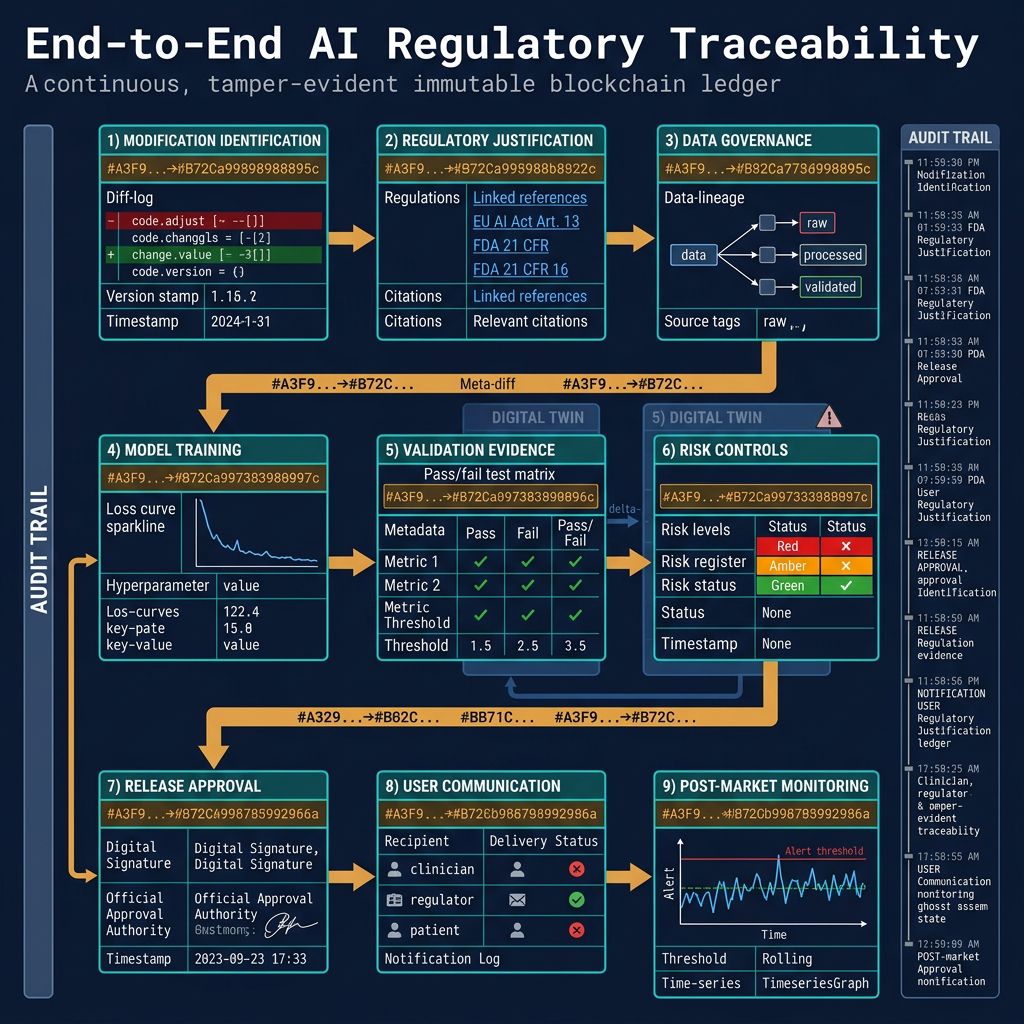
The FDA emphasizes end-to-end traceability. Each modification must link to regulatory justification, datasets, retraining, validation, risk controls, approvals, release, and post-market monitoring.
An effective traceability framework creates an auditable chain documenting what changed, why, how it was validated, who approved it, release details, and ongoing monitoring.
This approach makes PCCP a dynamic regulatory control system, not a static document.
This is where continuous validation becomes practical. Prior xLM discussions highlight that AI validation must cover performance, robustness, explainability, fairness, drift, human oversight, traceability, and continuous monitoring beyond initial testing. Annex 22 frames regulated AI as a lifecycle-controlled system requiring intended use, test metrics, data controls, model testing, acceptance, release, maintenance, and continuous validation. For AI-enabled MedTech, PCCP expresses this: AI may improve only within a system of predefined change, evidence, risk control, traceability, and oversight.
8.0. Continuous Intelligence and AI Lifecycle Automation
PCCP implementation generates extensive evidence: data lineage, validation reports, retraining logs, risk assessments, approvals, release documents, and post-market records.
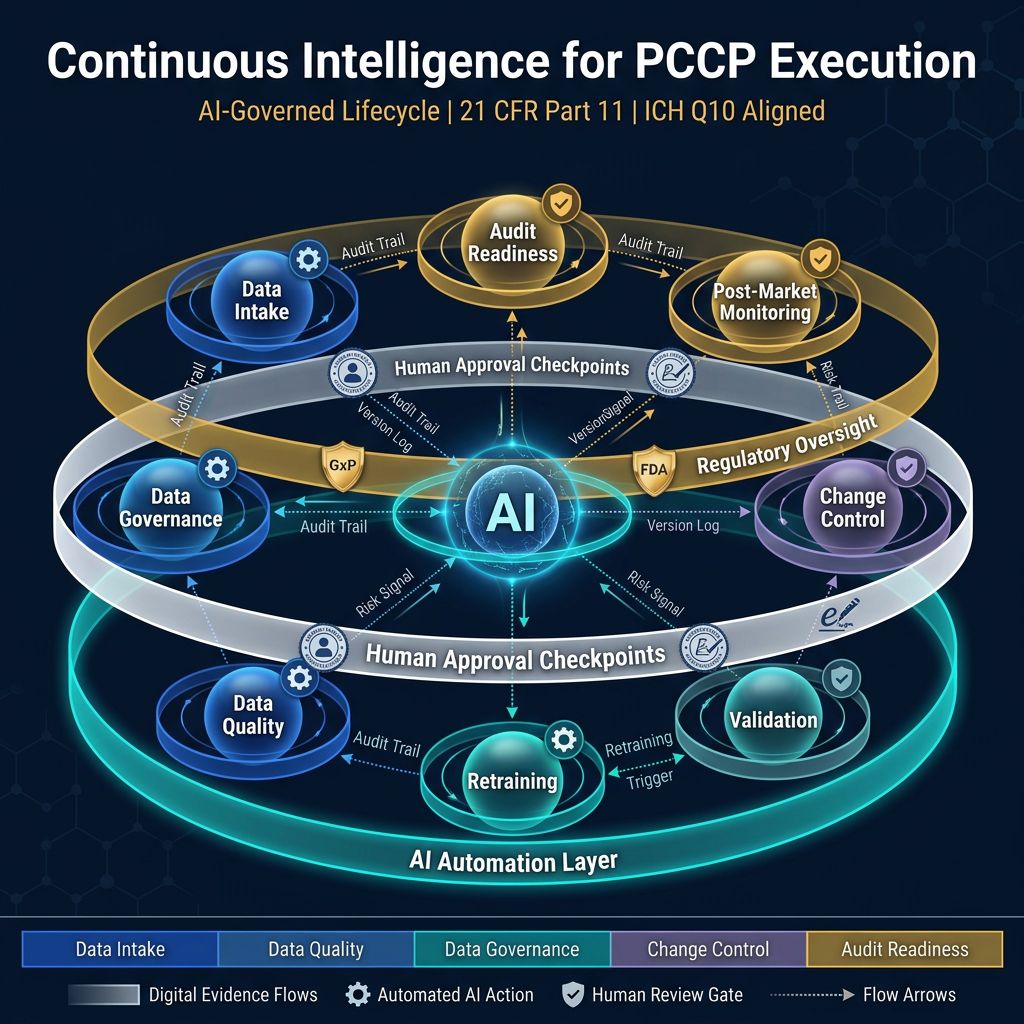
This is where Continuous Intelligence platforms are vital. They orchestrate evidence generation, automate traceability, monitor performance, manage exceptions, and support human oversight throughout the AI lifecycle.
Continuous Intelligence automates data quality checks, dataset version control, bias monitoring, retraining documentation, validation, change control, labeling, post-market surveillance, and audits.
Automation's greatest value is not just efficiency but establishing continuous regulatory continuity, where every AI change generates a complete, verifiable evidence package ensuring compliance, safety, and effectiveness.
9.0. Governance, Escalation, and Human Oversight
Despite AI automation advances, the FDA stresses human accountability. Organizations must define governance mechanisms specifying when automation stops and human review begins.
Escalation triggers include performance drops, dataset drift, subgroup bias, cybersecurity issues, unexplained behavior, unmet criteria, adverse trends, or protocol noncompliance.
Effective governance requires coordination among AI teams, regulatory affairs, quality assurance, clinical safety, software engineering, cybersecurity, and post-market surveillance.
The FDA's message: adaptive AI demands more sophisticated, continuous oversight, not less.
10.0. Strategic Implications for the Future of AI Regulation
The FDA's PCCP guidance invites innovation within clear regulatory boundaries. It authorizes predefined, validated, risk-controlled changes under continuous oversight, not unrestricted AI evolution.
Success under this framework depends less on advanced AI algorithms and more on technical control, regulatory discipline, data governance, continuous validation, and traceable decision-making.
PCCP transforms adaptive AI from experimental to a controlled engineering discipline.
For MedTech, this creates a new regulatory model where AI innovation, continuous validation, risk management, and regulatory compliance form an integrated lifecycle system.
The FDA has created a pathway for adaptive AI devices. Manufacturers must prove adaptation is disciplined, validated, and continuously governed change, not improvisation.
Know More About xLM Continuous Intelligence
About the Authors

About Nagesh Nama
Nagesh Nama is the Founder and CEO of xLM Continuous Intelligence and ValiMation, bringing nearly 30 years of experience in AI-driven GxP compliance, computer system validation, and regulatory technology for the life sciences industry. A recognized thought leader, he pioneered the industry's first Continuous Validation platform supporting compliant IaaS, PaaS, and SaaS environments under 21 CFR Part 11 and Annex 11. His work focuses on advancing intelligent validation, AI-powered compliance, predictive maintenance, temperature mapping, and GxP AI agents to help pharmaceutical, biotechnology, and medical device organizations accelerate digital transformation while maintaining continuous compliance. Nagesh is a member of the Forbes Technology Council and the Fast Company Executive Board, a contributor to Forbes and Fast Company, and has been featured by Microsoft for his work in AI agents.