QIG: How Europe Is Shaping Pharmaceutical Innovation
Explore how xLM combines Human-in-the-Loop AI, audit trails, and continuous validation to strengthen GxP compliance, data integrity, inspection readiness, and

1.0. Introduction
A pharmaceutical company deploys an AI model to optimize a continuous manufacturing line. During testing, the model performs well, predicts process behaviour, and helps engineers identify opportunities to improve efficiency. The team is confident. The technology appears ready.
Then a regulatory question changes the conversation, What is the model’s intended use? How does it influence the control strategy? What happens if its performance changes? And where does human oversight sit?
These are not questions that can be answered with a successful demonstration alone. They require a clear scientific rationale, an understanding of risk, and evidence that the technology performs appropriately within its intended role.
For companies developing AI-enabled manufacturing processes, waiting until a regulatory submission or inspection to address these questions can create expensive redesigns and delays. The more deeply a technology becomes embedded in an operating process, the harder it may be to change its role, controls, or supporting evidence.
This is why the European Medicines Agency’s Quality Innovation Group (QIG) deserves attention. Its work offers pharmaceutical companies an opportunity to engage with emerging technologies earlier, understand the regulatory questions they may raise, and build evidence into innovation from the beginning.
The central shift is significant, regulatory readiness needs to become part of technology development, not a final checkpoint before implementation.
2.0. What Is the EMA Quality Innovation Group?
The Quality Innovation Group (QIG) is an EMA group that helps the European regulatory network understand emerging technologies and innovative approaches affecting pharmaceutical quality and manufacturing. It supports horizon scanning, knowledge exchange, and engagement with developers to help regulators anticipate scientific and regulatory challenges.
QIG is not an approval body for individual technologies. Its value lies in creating opportunities to discuss innovations that may not fit neatly into established manufacturing or quality practices, helping industry and regulators develop a clearer understanding of the questions involved.
Its work has covered continuous and decentralized manufacturing, pharmaceutical process models, digitalisation, automation, digital twins, artificial intelligence, robotics, platform technologies, and personalised medicines.
The group's 2026–2028 rolling work plan places particular emphasis on sustainability in pharmaceutical manufacturing, while its published work on process models addresses mechanistic, empirical, and hybrid approaches, including machine-learning models.
Consider the difference between a conventional manufacturing process and one that relies on an AI-enabled model. The conventional process can be assessed using established qualification, validation, and process-control expectations. The AI-enabled process may introduce additional questions about data dependencies, model behaviour, decision-making, human oversight, and ongoing change.
The question is no longer simply whether a technology is innovative. It is whether its intended use, risks, controls, and evidence can be understood and defended.
For pharmaceutical leaders, QIG represents an opportunity to understand these questions before they become obstacles to implementation. That leads to the next issue: when should the conversation begin?
3.0. Why Early Regulatory Engagement Matters
Imagine a company developing an AI-driven donor selection platform for cell therapy. The technology could help researchers evaluate information and support decisions during development, but its regulatory implications depend on how the company intends to use it.
Will the platform support exploratory research? Will it recommend which donors to prioritize? Will its output directly influence a manufacturing or quality decision?
Each use creates a different relationship between the technology, the decision-maker, and the potential consequences of an incorrect result.
Engaging QIG early gives the company an opportunity to discuss these questions while the system's intended role and design are still being defined. It can clarify the scientific and regulatory challenges, explain the proposed approach, and explore which issues may require further evidence or consideration.
EMA's published process allows developers to request individual one-to-one QIG meetings by submitting a short description of the technology, the scientific or regulatory challenges, and proposed solutions.
The meetings are free and normally virtual, typically last around 1.5–2 hours, and are intended to take place early in development, before formal scientific advice. QIG engagement may also be relevant to technologies associated with products already authorized, depending on the question and circumstances. Companies should consult the current EMA process for eligibility and arrangements.
This is not a shortcut around regulatory requirements. It is a way to identify the right questions before major development decisions become difficult to reverse.
Instead of waiting until a technology reaches a formal submission or inspection, organizations can discuss its scientific rationale, intended use, regulatory questions, and potential control strategy while it is still being developed.
EMA's published QIG activities illustrate the range of emerging technologies attracting discussion, including digital twins, AI applications in CAR-T manufacturing, computer vision for microcarrier counting, and AI-supported donor selection. These examples demonstrate the breadth of industry questions being explored, they should not be interpreted as evidence that QIG has approved or endorsed the technologies.
4.0. A mini case study: The digital twin decision
Consider a hypothetical company using a digital twin to optimize a continuous manufacturing line. The team initially views the model as an engineering tool, but later proposes using its predictions to influence operational decisions.
That change matters. Early engagement with QIG could help the company frame the questions it needs to resolve about the model's role in the control strategy, its data dependencies, the evidence supporting its intended use, and the circumstances that should trigger reassessment or revalidation. These are questions for discussion, not guaranteed outcomes of a QIG meeting.
The lesson is straightforward, clarify the regulatory questions before locking in the design. Early engagement can help teams recognize gaps while they still have time to address them.
Want to learn how to defend AI decisions in GxP compliance?
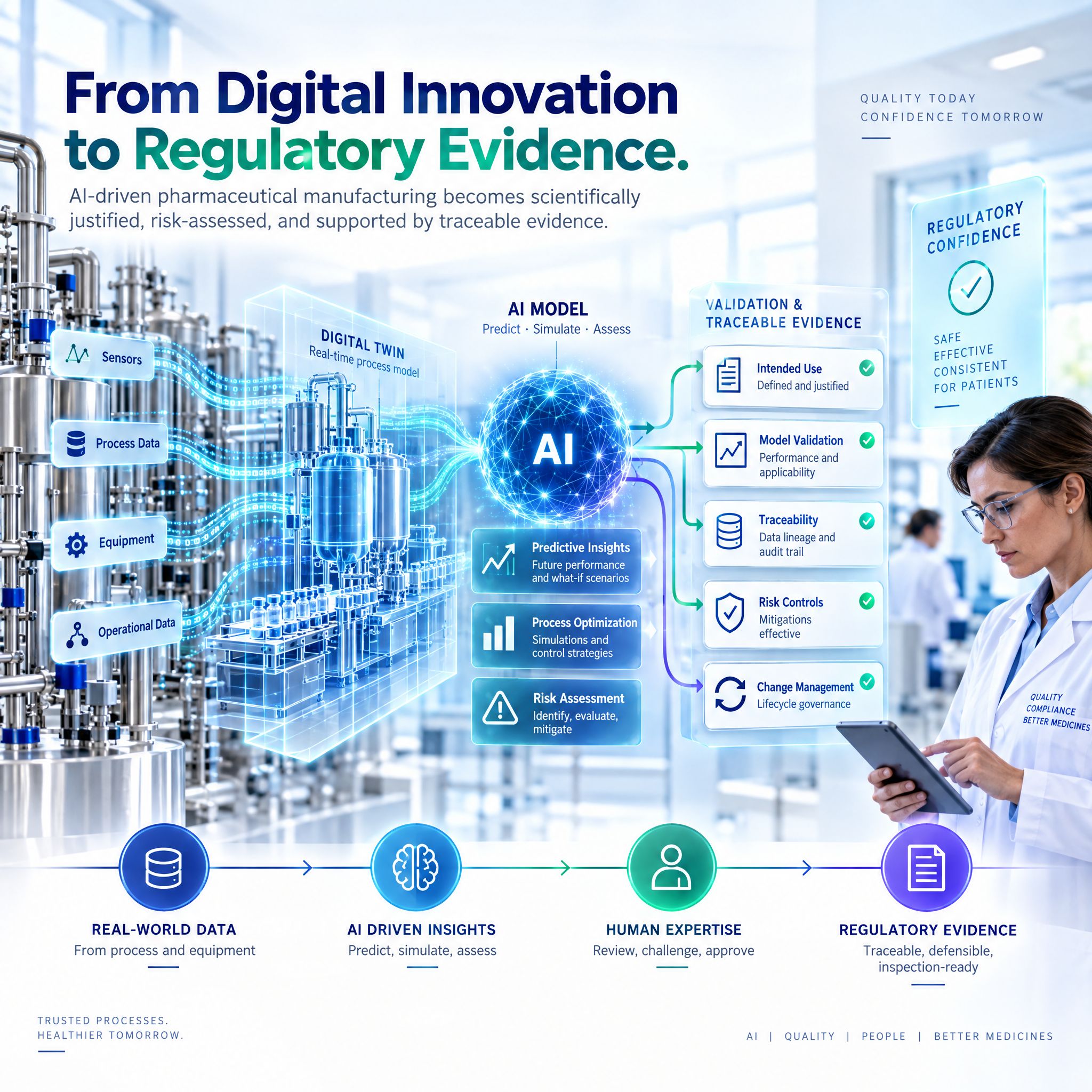
5.0. From Digital Innovation to Regulatory Evidence
Here is where the conversation changes. Understanding a technology is only part of the challenge; understanding what the technology is expected to do is equally important.
Context of Use (COU) describes the specific circumstances and purpose for which a technology or model will be used, including the role its outputs play in a process or decision. An AI model used for exploratory analysis does not carry the same implications as one that recommends a manufacturing intervention. A model that automatically changes process parameters introduces a different level of consequence again.
The underlying technology may be similar. Its regulatory significance depends heavily on its intended use, the decisions it influences, and the risks associated with its output.
EMA's preliminary QIG considerations on pharmaceutical process models provide a useful reference point. They discuss mechanistic, empirical, and hybrid process models and emphasize defining the model's intended use, its function within the control strategy, and its role in decision-making. The document includes machine-learning models within its discussion and notes that the principles may also apply to AI.
For manufacturers, this means model performance cannot be considered in isolation. Teams need a defensible explanation of what the model is intended to support, what evidence is appropriate for that purpose, how its limitations are understood, and where human judgment remains necessary.
The technology may be similar. The intended use and decision-making role are different.
This is the foundation of evidence-driven AI adoption. Rather than asking whether AI is acceptable in the abstract, organizations can build a case around a defined use, its risks, the controls applied, and the evidence that supports its role.
6.0. QIG and the Evolution of Pharmaceutical Manufacturing
QIG's work reflects a broader transformation across pharmaceutical manufacturing. Continuous processes, digital twins, AI, robotics, platform technologies, and personalized medicines are changing how products are developed, monitored, and manufactured. These innovations increasingly connect data, software, equipment, and human decisions across operational workflows.
As those connections grow, the limitations of isolated compliance milestones become more apparent. A validation package created once and reviewed months later may not fully represent a system whose configuration, integrations, data, or AI components continue to evolve.
That does not make traditional validation obsolete. It means organizations need to connect initial qualification and validation with ongoing change assessment, monitoring, and documented decisions about when further testing is necessary.
The emerging challenge is not simply digital validation. It is how to maintain continuous confidence in a continuously changing environment.
For quality and regulatory teams, this requires a closer relationship between innovation, operational monitoring, and the evidence used to demonstrate continued control.
Want to understand AI credibility in FDA decisions?
7.0. What This Means for Pharmaceutical Leaders
The practical takeaway is that companies need to prepare for regulatory questions while their technology is still taking shape. That starts with defining intended use and context of use, understanding the role of the technology in operational decisions, and identifying what evidence will be needed to support its adoption.
It also requires distinguishing AI governance from AI assurance. A policy can establish that AI must be monitored. A governance framework can define who is responsible. But regulated organizations ultimately need objective evidence showing that the technology was appropriately configured, verified, controlled, monitored, and maintained.
Governance defines what should happen. Evidence demonstrates what actually happened.
This is where Continuous Intelligent Validation (cIV) fits naturally into the discussion. By applying AI to validation activities such as requirements development, risk assessment, test generation, and traceability, cIV can help connect validation work and supporting evidence across the system lifecycle.
The objective is not to automate regulatory judgment or assume that generated documents guarantee compliance. It is to make validation activities more efficient and evidence more connected, while retaining qualified human review and approval.
For pharmaceutical organizations exploring AI-enabled manufacturing or digital systems, this represents a practical extension of the QIG principle: identify the questions early, build the right controls, and make the evidence part of the development process rather than assembling it at the end.
8.0. The Future of Pharmaceutical Innovation Is Evidence-Driven
Can regulatory readiness be something addressed only when a submission or inspection is approaching? Or does it need to become part of the technology lifecycle itself?
As pharmaceutical companies adopt more sophisticated models and connected manufacturing systems, these questions will become increasingly important. The ability to explain intended use, demonstrate control, and show how decisions were reached will matter alongside technical performance.
QIG's early-engagement approach offers one avenue for exploring emerging regulatory questions. Within organizations, evidence-centric validation and lifecycle oversight can help translate those questions into practical development and quality activities.
The opportunity is not to eliminate uncertainty from innovation. It is to identify uncertainty earlier, understand its implications, and build a reasoned approach to managing it.
That is ultimately the opportunity behind early regulatory engagement: not slowing innovation down, but creating the conditions in which innovation can move forward with confidence.
9.0. Closing: Build Regulatory Readiness Into Innovation
Pharmaceutical innovation needs more than promising technology. It needs a clear intended use, a defensible scientific rationale, appropriate controls, and evidence that supports decisions throughout the lifecycle.
For organizations exploring emerging manufacturing technologies, early engagement with bodies such as EMA's QIG combined with evidence-centric validation approaches such as xLM's cIV can help teams address regulatory questions before they become late-stage obstacles.
The future may belong to organizations that can combine innovation velocity with regulatory evidence.
About the Authors

About Nagesh Nama
Nagesh Nama is the Founder and CEO of xLM Continuous Intelligence and ValiMation, bringing nearly 30 years of experience in AI-driven GxP compliance, computer system validation, and regulatory technology for the life sciences industry. A recognized thought leader, he pioneered the industry's first Continuous Validation platform supporting compliant IaaS, PaaS, and SaaS environments under 21 CFR Part 11 and Annex 11. His work focuses on advancing intelligent validation, AI-powered compliance, predictive maintenance, temperature mapping, and GxP AI agents to help pharmaceutical, biotechnology, and medical device organizations accelerate digital transformation while maintaining continuous compliance. Nagesh is a member of the Forbes Technology Council and the Fast Company Executive Board, a contributor to Forbes and Fast Company, and has been featured by Microsoft for his work in AI agents.